
Outcomes for Impact
Making Progress on Hard-to-Solve Problems

Summary
We are good at counting things. We count event registrations, course completions, article downloads, dues renewals, and satisfaction scores. We track open rates, attendance trends, and year-over-year revenue variance. What we often lack is a coherent theory of change, a clear line connecting all these numbers to the problems our communities are hungry to solve.
This article is about building that line. It introduces the results chain: a framework for understanding how inputs and activities connect to outputs, outcomes, and impact. And it offers a way to think about metrics not just as scorecards, but as a system for navigating toward something meaningful.
I lead the product community, a product development learning community designed specifically for associations. Let’s compare ideas and build something great.
The Results Chain
“Outcomes are changes in human behavior that drive business results.”
Josh Seiden
I previously covered metric basics and the distinction between KPIs (management health) and OKRs (strategic performance). This article digs into the architecture of results and what it looks like to measure work that moves the needle. A results chain shows how deliberate actions produce intended results. Reading left to right, it traces a causal sequence from what we invest, to what we do, to what we produce, to what changes and ultimately, to what matters. Here are the key terms:
Inputs are the resources we bring to bear (staff time, budget, expertise, data, relationships). They are the raw material of organizational work. Activities are what we do with those inputs. They are the planned actions, programs, and processes that convert resources into something deliverable. Outputs are the tangible results of our activities: a conference delivered, a course completed, a toolkit published, a certification awarded. Outputs are measurable, discrete, and often the primary currency of association reporting.
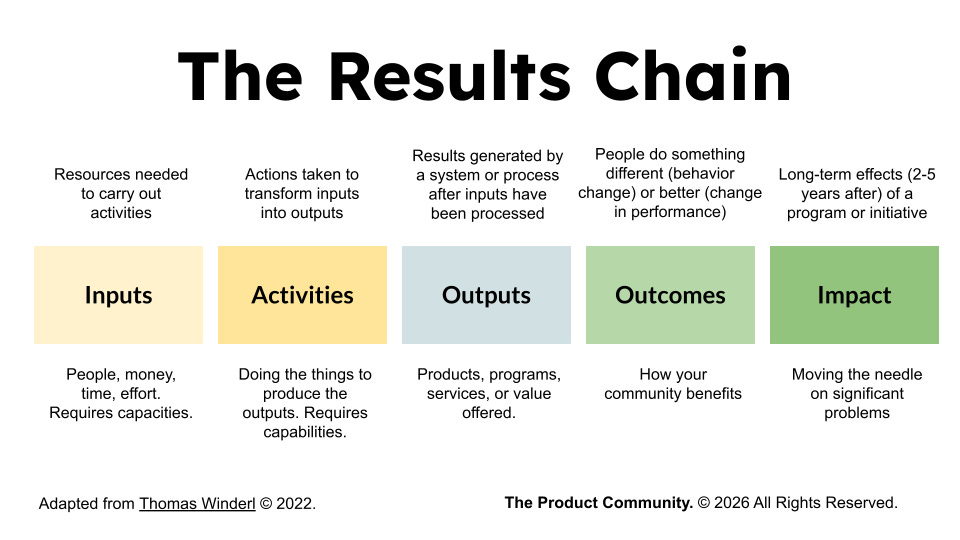
Outcomes are what changes as a result of those outputs (in the knowledge, skills, behaviors, relationships, or conditions of the people we serve). Outcomes put the member at the center. They shift our question from What did we produce? to What changed because we produced it? Impact is the longer-term effect of accumulated outcomes. It is movement on the larger problems our community exists to address. Impact is often beyond our direct control, but it is the north star that should orient everything else.
Here is a concrete example, grounded in association practice:
Input: A member SME and 40 hours of curriculum development time.
Activity: Design and delivery of a professional development workshop on regulatory compliance.
Output: 120 members complete the workshop and receive a certificate of participation.
Outcome: Members apply updated compliance knowledge in their organizations, reducing error rates and regulatory exposure.
Impact: The profession demonstrates measurably improved compliance standards industry-wide, supporting advocacy and public trust.
The difference between organizations that merely operate and those that transform is often their clarity about where on this chain their real work lives. Most associations are deeply fluent in outputs. They are far less practiced at designing for outcomes and almost none have a coherent strategy for demonstrating impact.
This is understandable because outputs are visible, attributable, and easy to count. Outcomes require longer time horizons, harder measurement, and a willingness to hold ourselves accountable to results we don’t fully control. Impact requires even more: patience, rigor, and institutional humility.
The case for investing in the full chain is powerful. When we design for outcomes, we naturally make better decisions about outputs. We stop running programs because we’ve always run them and start asking whether they change anything. We stop measuring attendance as a proxy for value and start measuring whether value actually transferred. Digging into different metric types helps us demonstrate the power of the results chain.
Metrics of Varying Depth
“No methodology can guarantee success. But a good methodology can provide a feedback loop for continual improvement and learning.”
Ash Maurya
Not all metrics are equal. A useful way to understand the difference is to map them against the results chain from low-impact indicators tethered to inputs and outputs, through medium-impact indicators that begin to capture behavior change, to high-impact indicators that reveal progress on consequential, mission-level problems. Here is what that looks like in practice:
Low-Impact Metrics (Input and Output Indicators). These are the metrics most associations already track. They are necessary but insufficient. They tell us whether we are operating, not whether we are mattering.
Clicks and opens. Website traffic, email open rates, content downloads. Example: A white paper was downloaded 800 times.
Attendance. Event headcount for conferences, webinars, and workshops. Example: Annual conference drew 950 attendees.
Revenue. Dues income, registration fees, sponsorship totals. Example: Education revenue grew 8% year over year.
Retention and churn. Membership renewal rates and lapse rates. Example: Membership retention held at 84%; churn decreased by 2 points.
These metrics are important. They indicate operational health and financial sustainability. The problem arises when they become the ceiling of ambition rather than the floor.
Medium-Impact Metrics (Behavioral and Relational Indicators).These metrics begin to probe whether something has changed: in what members know, how they behave, or how they connect with one another. They require more intentional measurement design, often including follow-up surveys, cohort tracking, or structured observation.
Learning transfer. Did members apply what they learned? Example: 65% of course completers reported using new frameworks in their work within 90 days.
Satisfaction with depth. Not “did you enjoy it?” but “did it change how you think or work?” Example: Net Promoter Score of 74 among program participants.
Peer collaboration. Are members learning from and with each other — not just from us? Example: 28 member-initiated working groups launched through the community platform.
Resource application. Are tools, templates, and knowledge assets being put to use? Example: A compliance toolkit was actively referenced by 40% of member organizations.
Community participation. Engagement in forums, peer networks, mentoring relationships, and co-creation. Example: Forum participation increased 35%; 120 members joined a peer-mentoring cohort.
Medium-impact metrics reflect genuine value exchange. They are harder to collect and harder to attribute, but they are the bridge between what we produce and why it matters.
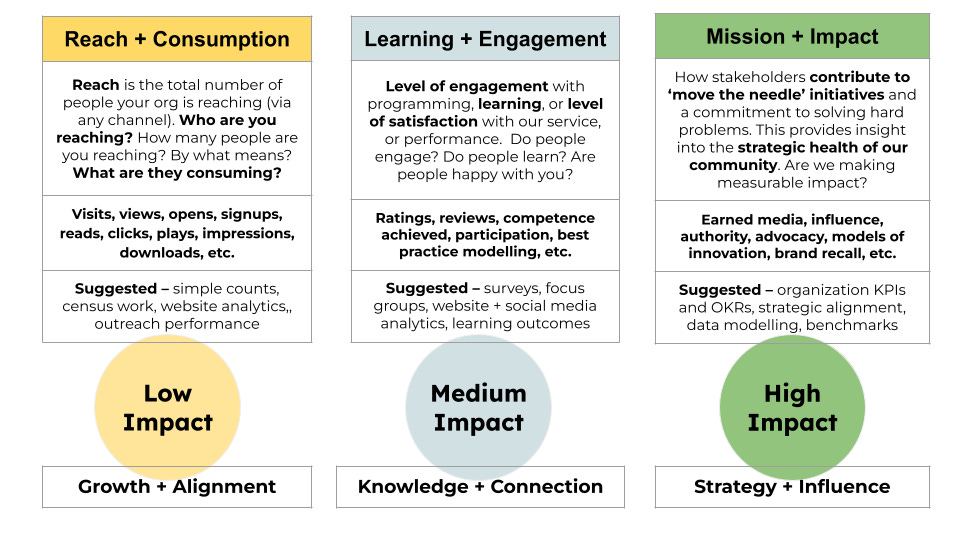
High-Impact Metrics (Outcome and Mission Indicators). These are the metrics most associations rarely talk about and almost never systematically measure. They are the answers to the question we were founded to pursue: Are we actually making progress on the problem?
Workforce advancement. Are members advancing in their careers and earnings because of their engagement with the association? Example: Members who completed a credentialing pathway reported a 22% increase in salary within three years.
Industry practice improvement. Are professional standards rising? Is the field changing? Example: A CPD program contributed to a measurable increase in adoption of evidence-based practices across member organizations.
Systemic change indicators. Movement on the structural conditions the profession or field faces — regulatory, environmental, social, economic. Example: Association advocacy contributed to passage of legislation improving workplace safety conditions for 200,000 workers.
Equity and access outcomes. Are underrepresented members gaining access, credentials, and community at higher rates? Example: Scholarship program participants from underrepresented groups achieved licensure at rates comparable to the full member population.
North Star (Moonshot) Metrics. The overarching, long-term signal that tells you whether the community’s deepest purpose is being realized. Example: The association’s “40 by 30” goal: 40% reduction in industry-related carbon emissions by 2030, tracked annually with transparent progress reporting.
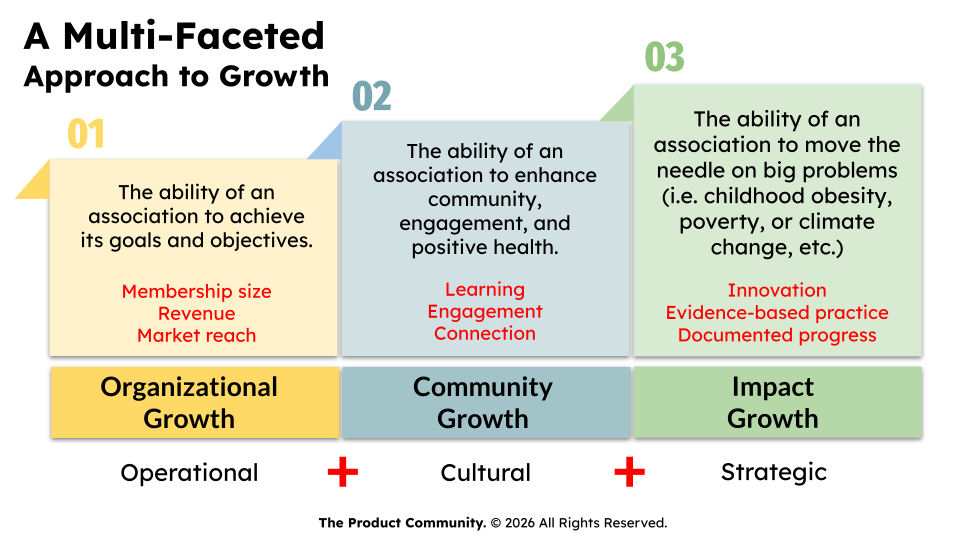
These are hard because they require longitudinal data, partnerships with researchers, honest conversations about attribution, and the organizational courage to report results you did not achieve as readily as those you did. They also require something rarer still: a community that has agreed, explicitly, on what we are trying to accomplish in the world.It’s important to pursue a multi-dimensional understanding of growth, one that encompasses organizational health, community vitality, and field-level impact simultaneously. The results chain and the metrics hierarchy give that frame some operational teeth.

Operational metrics (low-impact) tell us whether we are well-run and financially stable. This is the foundation without which nothing else is possible.
Community metrics (medium-impact) tell us whether we are building the quality of connection and learning transfer that makes membership meaningful.
Mission metrics (high-impact) tell us whether the community’s collective work is moving the needle on something consequential, the proof that we are not merely serving members, but building something with them toward a shared purpose.
Ideally, we design for all three simultaneously, without letting any one crowd out the others. Revenue without mission is a business. Mission without revenue is aspiration. Revenue and mission without community is neither sustainable nor transformative.
We Exist to Make Impact
“Tackle mysteries by living in the world and observing it thoughtfully and rigorously. Analyze your observations, draw conclusions, and create new theories.”
Roger Martin
We don’t exist to manage memberships. We exist to come together to learn, connect, and create impact in our professions, industry, or world. This animating purpose is available to us, but runs through three commitments:
Lead well. Invest in governance, aligned leadership, and a culture of trust between staff and volunteers. This makes us capable of creating focused and sustained value, the precondition for everything else.
Strategize clearly. Build and execute a strategy that sharpens our identity, deepens our value proposition, and makes us an indispensable choice for our members. This builds knowledge, connection, and the credibility to pursue ambitious goals.
Design for a realistic moonshot. Name the problem we exist to solve. Be specific about. Measure progress honestly and publicly. Accept that we will not get there alone or quickly. Design our products, programs, and community so that the work members do through our association accumulates into genuine progress.
When we do these three things together, we stop competing on features and start competing on meaning.
About the Author
James Young is founder and chief learning officer of product community®. Jim is an engaging trainer and leading thinker in the worlds of associations, learning communities, and product development. Prior to starting product community®, Jim served as Chief Learning Officer at both the American College of Chest Physicians and the Society of College and University Planning. Please contact me for a conversation: james@productcommunity.us