
A Fully-Engaged Membership
Tapping the Invisible Engine of Intrinsic Motivation to Power Member Engagement and Build a Thriving Community

Summary
Associations spend considerable energy trying to boost member engagement through external rewards: discounts, certifications, networking events, and exclusive content. This might work in the short run, but I believe vibrant professional communities are powered by something far more fundamental: the intrinsic motivations that draw professionals to connect, contribute, and grow alongside their peers.

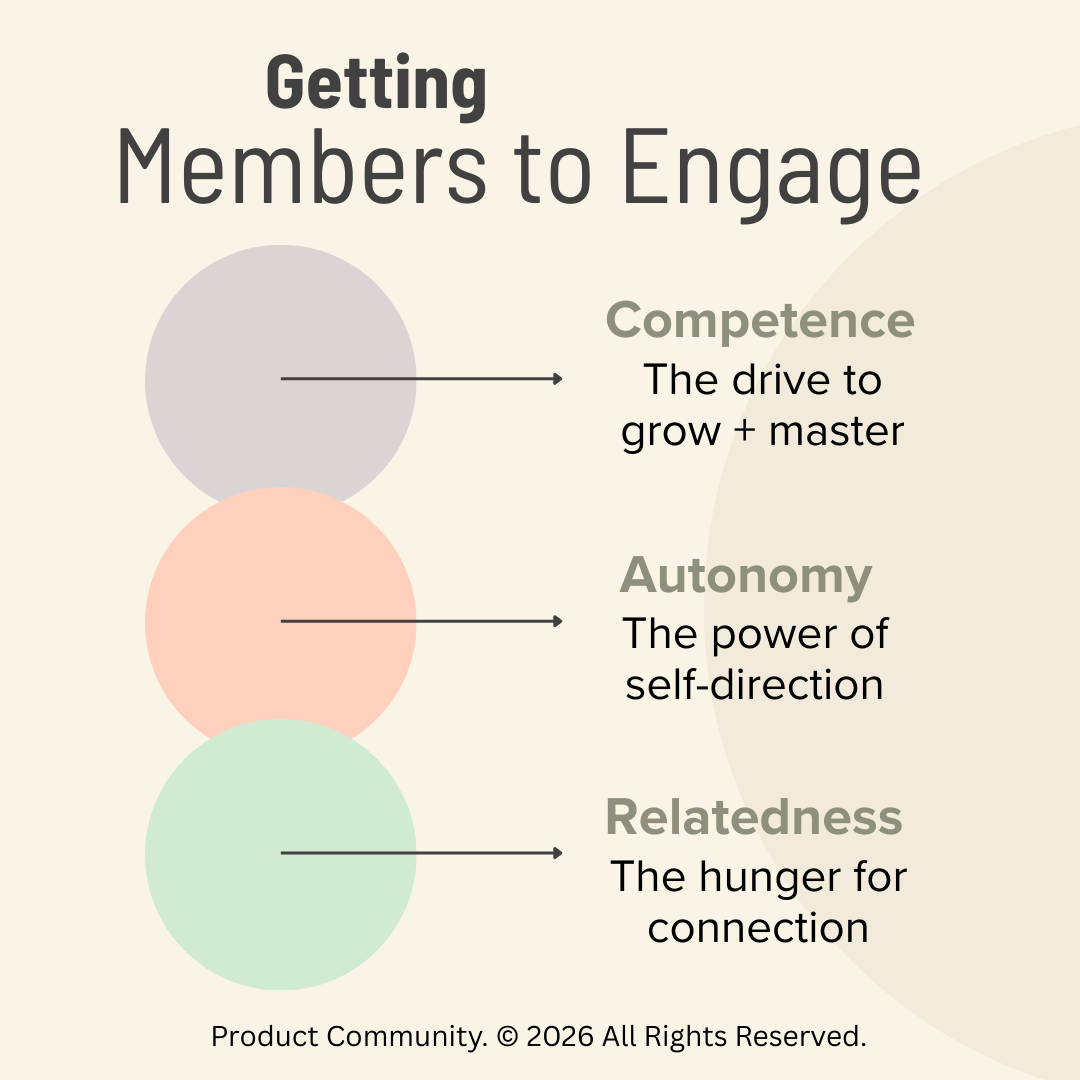
This is an article about understanding and tapping into three fundamental human needs: the drive to grow and master, the power of self-direction, and the hunger for connection. This will help us engage young professionals, diversify revenue, and build broad-based and infectious community.
I lead the product community, a product development learning community designed specifically for associations. Let’s compare ideas and build something great.
Getting Members to Engage
“The ultimate freedom for creative groups is the freedom to experiment with new ideas. Some skeptics insist that innovation is expensive. In the long run, innovation is cheap. Mediocrity is expensive and autonomy can be the antidote.”
Tom Kelley
Engagement can mean lots of things: proactive outreach, peer collaboration, offering discounts to get numbers, volunteer work, or designing events to expose members to new ideas and people. The trick is how we go about engaging our membership. Do we focus on extrinsic (i.e. compliance, status, etc.) or intrinsic (originating from within)? This article focuses on intrinsic motivation and the three basic human needs that spark engagement: the drive to grow and master, the power of self-direction, and the hunger for connection.
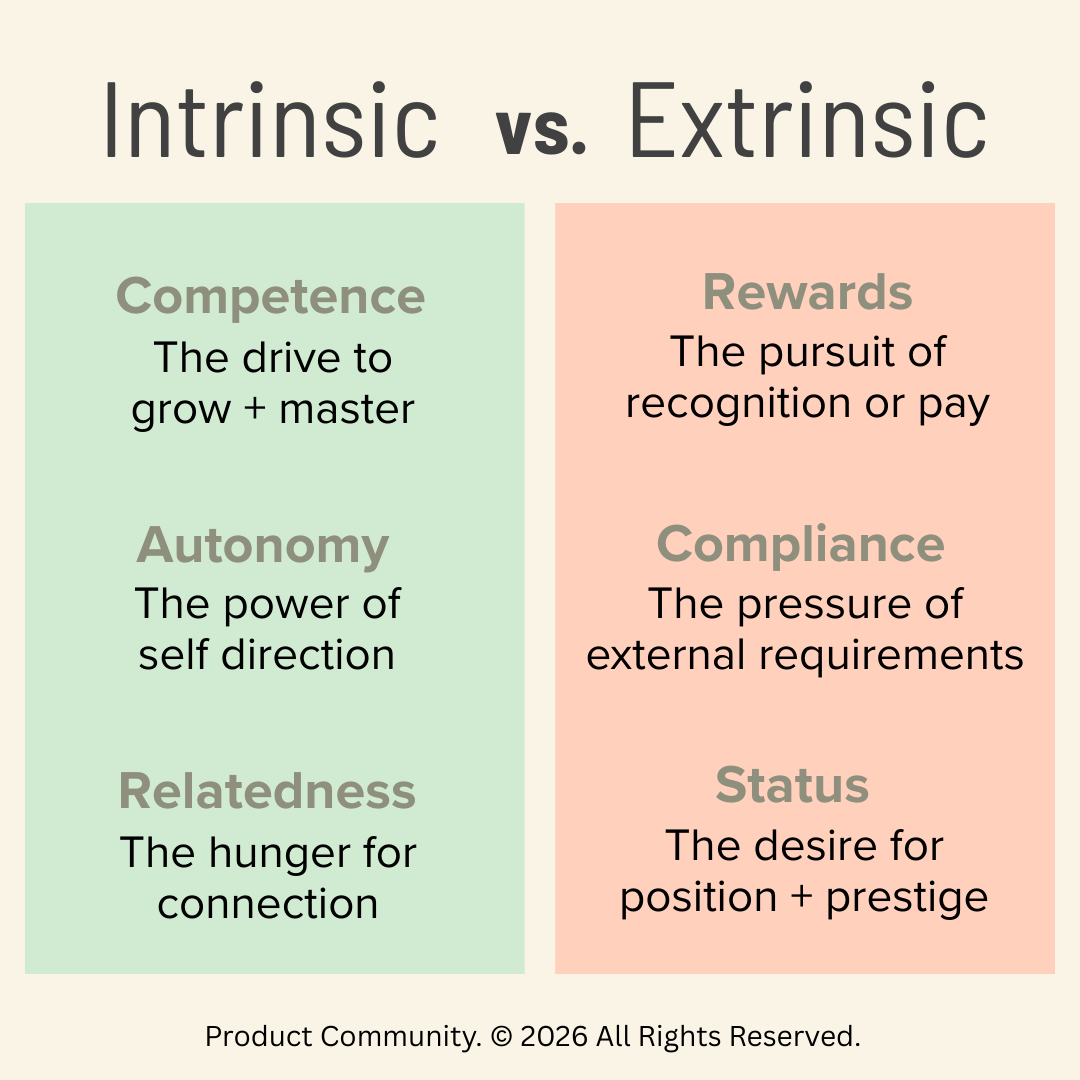
The power of intrinsic motivation to drive engagement is supported by Edward Deci and Richard Ryan’s Self-Determination Theory (popularized by Daniel Pink book Drive: The Surprising Truth About What Motivates Us). At its core, SDT identifies three universal psychological needs that, when satisfied, unlock sustained engagement: competence, autonomy, and relatedness.
Competence: The Drive to Grow and Master
Every professional wants to feel capable. This is the satisfaction that comes from developing expertise and increasing ability to create value. In associations, competence comes from engaging with (and learning from) peers who’ve faced similar obstacles, to test ideas in a supportive environment, and to progressively tackle harder-to-solve problems.
For instance, consider how a new member might start by asking questions in an online forum, then contribute answers (based on accumulated experience), eventually leading discussions, guiding others, or mentoring colleagues. Each step builds confidence while creating value for the broader community. The key is making these progression paths visible and achievable, so members can see their growth trajectory and feel the satisfaction of advancing their knowledge and expertise.
This approach helps transform passive content consumption into active skill development. When members solve real problems together, they build competence in a way that no webinar or white paper could match. The community becomes a lab for professional growth, where members can experiment, fail safely, and iterate toward mastery.
Autonomy: The Power of Self-Direction
Most professionals don’t want to be told what to learn or how to engage; they want to chart their own course based on their unique challenges or aspirations. This need for autonomy clashes with traditional association structures that offer one-size-fits-all programming and rigid committee hierarchies. The most successful communities create frameworks that enable meaningful choice and self-direction.
Think of community as an ecosystem rather than an org chart. In healthy ecosystems, participants choose their own paths while contributing to the whole. An association might provide the platform and tools, but members decide how to use them. Some might form study groups around emerging technologies; others might collaborate on industry research. Still others might create peer mentorships or regional innovation labs. Over time, our role shifts from directing traffic to enabling connections and removing barriers to member-initiated action.
This shift requires courage. It means loosening control over programming and trusting members to identify their own needs. It means creating spaces for organic collaboration rather than forcing participation through committee assignments. Most importantly, it means measuring success not by attendance, but by the vibrancy of member-initiated activities. When members feel genuine ownership over their community experience, engagement transforms from obligation to opportunity.
Relatedness: The Hunger for Connection
Humans are social creatures. We crave belonging, understanding, and mutual support. This need for relatedness is about finding others who understand our challenges, share our values, and care about our success. The most powerful association communities create what Robert Putnam calls both bonding capital (connections with similar others) and bridging capital (connections across differences).
Creating genuine relatedness requires moving beyond transactional exchanges toward authentic relationships. This happens when communities facilitate vulnerability and reciprocity. For instance, a senior executive sharing a career failure or a peer offering help to a colleague without expecting immediate return both create a culture of generosity. When members see others as whole people relationships can evolve from networking to genuine connection.
Our challenge is creating the conditions where these authentic connections can form naturally. Traditional networking rarely fosters deep relationships. Instead, consider designing experiences that require collaboration toward shared goals. Working together on meaningful projects (i.e. solving industry challenges, advocating for policy changes, or creating educational resources) can build relationships through shared purpose. These collaborative experiences create stories and bonds that can persist long into the future.
The Multiplier Effect of Aligned Motivation
“Social capital and collective efficacy combine two basic concepts: the existence of a social network connecting people and the ways in which that network motivates people to behave in mutually supportive ways.”
Alan Mallach and Todd Swanstrom
When we successfully tap into all three motivational drivers simultaneously something magical happens: the community begins generating its own energy. Members who feel they’re growing (competence), have agency over their participation (autonomy), and belong to something meaningful (relatedness) result in powerful and infectious community.
This creates what network theorists call increasing returns; each new engaged member makes the community more valuable for everyone else. A member who joins to solve a specific problem (competence) might discover they enjoy mentoring others (relatedness) and eventually lead a special interest group (autonomy). Their participation enriches the experience for other members, who in turn contribute their own value. Over time, the community becomes alive and self-reinforcing.
For instance, an association for healthcare administrators creates online forums where members can ask questions and share solutions (competence). Members self-organize regional meetups and specialty working groups based on their interests (autonomy). Through collaborative problem-solving, they build trust and mutual support networks (relatedness). New members join for the vibrant peer community actively helping each other succeed.
Moving from theory to practice requires intentional design choices that prioritize intrinsic motivation over external rewards. Start by auditing your current community activities through the SDT lens. Does your mentoring program allow for self-matching based on interests (autonomy) or assign pairs based on demographics? Do your events focus on expert presentations (passive) or peer problem-solving (competence-building)? Are your online communities places for broadcasting association content or spaces for authentic member dialogue (relatedness)?
The shift toward intrinsically motivated communities also requires different success metrics. Instead of counting event attendees or content downloads, measure peer-to-peer interactions, member-initiated projects, and progression along competence pathways. Track not just renewal rates but the percentage of members who actively contribute to the community’s knowledge and connections. These metrics better capture the health of an intrinsically motivated community.
Perhaps most importantly, designing for intrinsic motivation means trusting your members. Trust them to identify valuable learning opportunities. Trust them to organize meaningful gatherings. Trust them to support each other without association intervention. This means creating scaffolding that enables rather than constrains member initiatives.
The Path Forward
“Human beings have an innate inner drive to be autonomous, self-determined, and connected to one another. And when that drive is liberated, people achieve more and live richer lives.”
Daniel H. Pink, Drive: The Surprising Truth About What Motivates Us
Associations need to understand and nurture the intrinsic motivations that drive professional engagement. By creating communities where members can grow competence, exercise autonomy, and experience genuine connection, we transform from service providers to indispensable platforms for professional growth.
This transformation requires letting go of command-and-control structures in favor of emergent, member-driven communities. It means measuring success not by what the association provides but by what members create together. Most fundamentally, it means recognizing that sustainable engagement comes not from external carrots and sticks but from satisfying the deep human needs that drive us all.

The beauty of intrinsic motivation is that it’s renewable and contagious. Members who experience growth, agency, and belonging naturally want to create those experiences for others. They become evangelists because they genuinely believe in the community’s value. They contribute to the satisfaction of helping peers succeed. By tapping into the invisible engine of human motivation, we can evolve from transactional service providers to transformational communities.
I lead the product community; we are a learning community because we believe great relationships help us create the value our members want. Remember, product-led growth fuels connection. Join the product community and flip your destiny.
About the Author
James Young is founder and chief learning officer of the product community®. Jim is an engaging trainer and leading thinker in the worlds of associations, learning communities, and product development. Prior to starting the product community®, Jim served as Chief Learning Officer at both the American College of Chest Physicians and the Society of College and University Planning. Please contact me for a conversation: james@productcommunity.us