
How to Execute
A Community Systems Approach to Strategy Implementation

Summary
Most association strategic plans fail because the systems governing daily behavior were built for a different purpose. This article is about systems design, which is the engine that makes strategy real. In associations, community is paramount. It’s how we engage, connect, learn, and grow. Our strategies can only come true if we tap and align this energy into a system of practice that creates momentum and helps us achieve our shared outcomes with courage and enthusiasm.

Associations possess a structural advantage that most organizations dream of. Properly designed, community is the execution system. Contributory value creation is the strategy in motion, embedded in every interaction, peer exchange, and act of shared knowledge-building. The associations that understand this can close the strategy-execution gap by creating a system of implementation that aligns with the future direction.
I lead the product community, a product development learning community designed specifically for associations. Let’s compare ideas and build something great.
The Strategy-Execution Gap
“A bad system will beat a good person every time.”
W. Edwards Deming
I love strategy so much that it’s one of my favorite things to write about. Here are some recent articles: what it means to play to win, why systems outperform plans, and what kind of membership makes all of it possible. Developing strategy to anchor our planning should not be a once every three year activity. Great strategy is embedded and alive, agile and adaptive. This is achievable, yes, but also much easier said than done. Great strategy is designed for execution. We improve our chances by making specific, shared choices on direction, positioning, value, and culture.
Despite our best intentions, we struggle to anticipate and plan for a rapidly changing world. But the real reason we can’t execute on our strategies is because our existing systems of practice, or how we run our associations, are out of tune with our ambitions. This creates a strategy-execution gap.
The scenario is familiar to anyone who has sat through a strategic planning retreat. The facilitated sessions are energizing, the resulting document is coherent, the goals are ambitious and feel right. And yet, six months later, you’re in a board meeting realizing that the day-to-day operations look almost identical to what they did before the plan was written. Goals don’t move the needle and plans won’t change the system. And the system (as it always does) won.
The conventional approach to strategic execution follows a logical sequence: set goals, develop project plans, assign responsibilities, track milestones. The flaw embedded in this approach is a hidden assumption: that our current organizational systems are configured to support the new strategic direction. They almost never are.
Your current systems — governance structures, resource allocation processes, meeting agendas, incentive models, cultural norms — were designed for your previous priorities. They have momentum and gravity. And when a new strategic initiative encounters an established system pulling in the opposite direction, the established system wins every time. Not because people resist change, but because systems are persistent by design.
Consider three scenarios:
The association commits to a new priority around member-led peer learning, but staff performance reviews still measure content output, not facilitated engagement. The system wins.
Leadership endorses a bold innovation agenda, but every budget request requires ROI justification based on historical performance data. The system wins.
The board adopts a strategy centered on cross-functional collaboration, but departmental reporting structures reinforce silos and protect turf. The system wins.
In each case, the goal was right, people were committed, and the plan was reasonable. None of it mattered because the underlying systems were designed for something else.
In Playing to Win, Roger Martin and A.G. Lafley frame their Integrated Cascade of Choices around five interconnected questions: winning aspiration, where to play, how to win, what capabilities must be in place, and what management systems (labelled here as Systems + Measures) are required. Associations that engage with this framework spend their energy on the first three and treat the final two as implementation details. This is an incomplete reading.
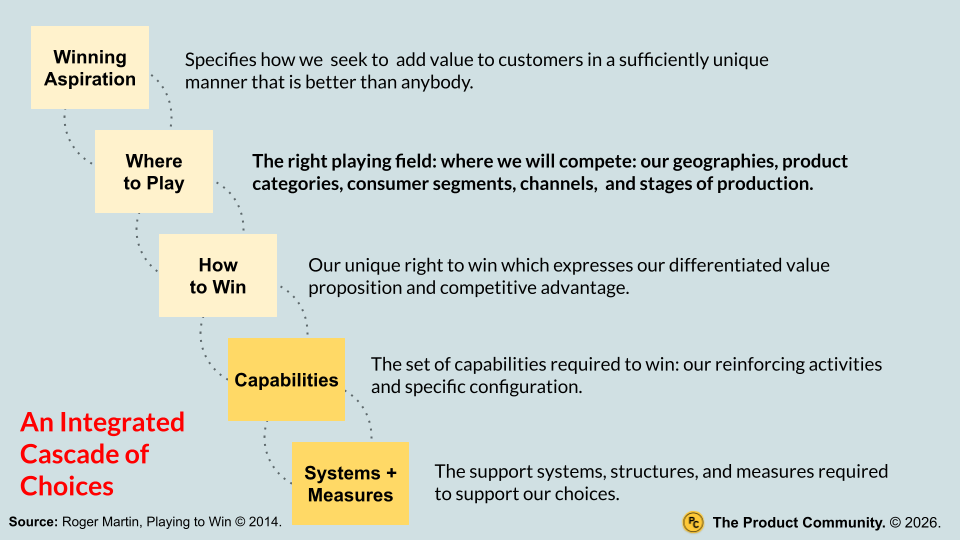
Capabilities and management systems aren’t the output of strategy. They are the mechanism through which strategy becomes real. As I’ve argued in Create Systems, Not Plans, systems provide the structures, processes, measures, and cultural conditions that enable consistent performance over time. They are the reason a good coach can build a championship program year after year, even as individual players come and go.
James Clear captures this distinction cleanly in Atomic Habits: “If you’re a coach, your goal might be to win a championship. Your system is the way you recruit players, manage your assistant coaches, and conduct practice.” Winners and losers often share the same goals. What separates them is the system behind the goal.
For associations, this means that the question “what are our strategic priorities?” should be reframed as “what systems are we designing to make those priorities the natural output of how we operate every day?”
Most organizations pursuing systems design face a fundamental challenge: the systems they need to build are external to the work itself. For instance, a technology company that wants to improve execution must redesign incentive structures, reporting processes, governance mechanisms, and cultural norms all of which sit alongside the core work of building products. The system and the work are separate. Associations shouldn’t have this problem.
When an association is built on contributory value creation, the community is the system. The daily work of membership — peer exchange, shared problem-solving, knowledge contribution, mentorship across career stages — is not a program running parallel to strategy execution. It is strategy execution. Every interaction is an act of value creation. Every contribution is a reinforcement of the organization’s capability to deliver on its winning aspiration.
In Membership is a System, I explored how a contributory membership model differs architecturally from a transactional benefits model. The transactional model assumes value flows in one direction from association to member, like water from a tap. The contributory model understands that real value in professional communities emerges from the connections among members: the knowledge they share, the problems they solve together, the relationships they build over a career.
What I want to add here is the strategic implication of that architecture: a contributory membership model is a strategy execution system. When members contribute to each other’s development, they are simultaneously generating the peer knowledge, shared language, and relational infrastructure that make an association’s strategic goals achievable in practice not as a separate initiative, but as the natural output of how the community operates.
Contributory Design as Strategic Infrastructure
“A network that depends on one leader is fragile. It’s just not how living systems work. So, instead of a pyramid, think of a garden. A gardener’s role isn’t to force every plant to grow in a specific way. It’s to create the fertile conditions — soil, water, light — for a wide range of plants to thrive.”
Adrian Röbke
Suppose an association sets a strategic goal to grow membership by 25% over three years. The conventional approach generates a project plan: marketing campaigns, acquisition incentives, outreach to non-members. On its face, this makes sense. However, alone this is insufficient. The systems design approach asks a different question: what is the system that would make membership growth the organic output of how the association functions?
The answer requires redesigning several things simultaneously. The member onboarding process must be redesigned to deliver immediate value. Not through a benefits checklist, but by embedding new members into live conversations where their fresh perspective is genuinely useful. The content development system must shift from broadcast to co-creation, so members see themselves as contributors rather than consumers. The performance metrics should move beyond renewal rates to track member-to-member connections, contribution patterns, and value creation cycles. The cultural norms around who counts as a valuable member must be examined and extended.
When you design these systems properly, membership growth evolves from a project that requires constant attention to an emergent property of how the association functions. New members arrive, contribute, and recruit others from their networks because the experience of membership is genuinely compelling. This is what Peter Senge means when he describes systems thinking as “seeing patterns of change rather than static snapshots.”
The goal of 25% growth remains; what changes is the system producing it. There is a phrase I used in my Playing to Win article that I want to return to: “strategy needs to be distributed, sustained, socialized, and reinforced.” At the time, I framed this primarily as a leadership and communication challenge. I want to reframe it now as a design challenge.
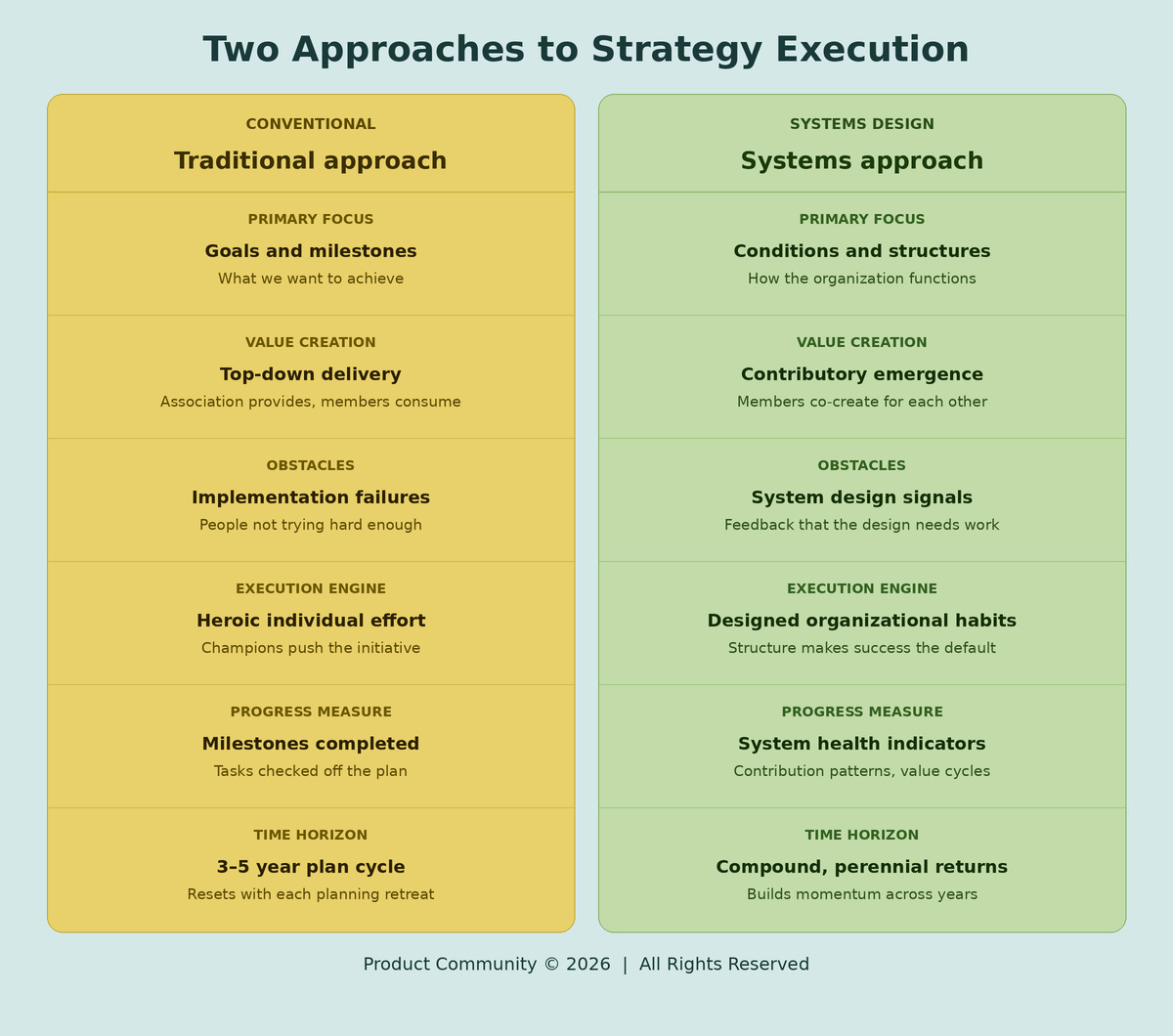
Strategy cannot be executed through quarterly reviews and annual planning cycles. It must be embedded in the daily rhythm of organizational life: in how meetings are run, how decisions are made, how resources are allocated, and above all, how members experience the community. The associations that close the strategy-execution gap are not the ones with the most disciplined project management. They are the ones that have designed their community interactions to continuously generate the outcomes their strategy calls for.
This is why community design and systems design are, ultimately, the same discipline applied to the same problem. When you design for contribution — building structures that make it easy for members to share knowledge, surface challenges, connect across career stages, and co-create solutions — you are building the execution infrastructure for every strategic goal the association has. You are building a system.
The compound returns that flow from this are when members see their contributions creating value for others, they stop evaluating membership on a cost-benefit spreadsheet. They become invested in the community they helped build. That investment generates the engagement, retention, referral, and advocacy that fuel sustainable organizational growth. And all of it is the natural output of a system designed to make contribution the default.
If you’re persuaded by this argument, the place to start is a systems audit. Before you write another strategic plan, ask these questions honestly:
What are the organizational systems — governance, budgeting, performance management, cultural norms — that currently govern how work gets done?
Which of these systems are aligned with our strategic priorities, and which are in tension with them?
Where is the community design work we’re doing — the peer learning, the peer matching, the contribution tracking — functioning as an execution system, and where is it still treated as a program?
The answers will tell you where to invest. As I outlined in the systems design framework: prioritize the high-leverage systems that disproportionately influence behavior. Prototype changes iteratively. Build feedback loops that surface whether the system is working. And perhaps most importantly, resist the temptation to treat this as a separate initiative. The design of your community and the design of your execution system are the same project.
A Specific Opportunity
“Durable ecosystems have multiple species.”
Richard Young
The business model of an association — a community of professionals paying to participate in a shared network of knowledge and relationship — is powerfully unique.
It is also structurally identical to what the leading organizational thinkers have been describing as the ideal execution system for decades. Donella Meadows calls it a system that produces its own pattern of behavior over time. Peter Senge calls it a learning organization. Roger Martin calls it a management system that enables consistently excellent performance. What all of them are describing, whether they know it or not, is a well-designed contributory community.

Associations have the raw material. The question is whether we will choose to design it deliberately. The associations that make this design investment — that treat community architecture as strategic infrastructure, that build contributory systems rather than benefits catalogs, that embed their strategic priorities in the daily rhythm of member interaction — will not need to manage a strategy-execution gap.
That is what it means to win. Not by crushing competitors or hitting growth targets in isolation. But by creating an organization whose daily operations are indistinguishable from its strategic ambitions because the system producing one is the same system producing the other.
I lead the product community. We are a learning community because we believe great relationships produce extraordinary outcomes. If this resonates, let’s build something together.
About the Author
James Young is founder and chief learning officer of the product community®. Jim is an engaging trainer and leading thinker in the worlds of associations, learning communities, and product development. Prior to starting the product community®, Jim served as Chief Learning Officer at both the American College of Chest Physicians and the Society of College and University Planning. Please contact me for a conversation: james@productcommunity.us