
Membership is a System
Why the Future of Associations Belongs to Contributors Not Consumers

Summary
Like I discussed in a recent article, traditional associations treat membership like a vending machine: insert dues, receive benefits. This transactional framework, built on one-way content delivery and episodic engagement, fundamentally misunderstands what professionals need from their communities. When we frame membership as a collection of benefits to be consumed rather than a system of value creation, we doom ourselves to diminishing returns, price sensitivity, and the constant churn of members who see little reason to stay once they’ve extracted what they came for.
In previous articles, I’ve explored how systems design replaces planning as the engine of strategic execution, how product systems connect offerings into coherent journeys, how capabilities systems position associations to win through differentiation, and how thought leadership fuels integrated value creation. This article asks: what kind of membership makes all of these systems possible? The answer requires us to rethink the membership relationship that moves beyond the transaction toward a living system.
I lead the product community, a product development learning community designed specifically for associations. Let’s compare ideas and build something great.
The Old Way No Longer Works
“I believe we still have a window to channel this craze for good: to cultivate a civic future where community members have the agency to shape their individual and collective lives, and where they are enmeshed in overlapping webs of relationships, associations, and commitments to share the joy, wonder, pain, grief, and messiness of the human experience.”
Sam Pressler
When I hear the word membership, I feel old-school tradition, small-town politics, clubbiness, and transactional benefits. What I want to feel when I hear the word membership is community, connection, progress, future, and an abiding reason to care.
The symptoms of the outdated approach are everywhere. We pump out standard content that gets consumed once and forgotten. We rely on annual conferences as our primary revenue driver, creating feast-or-famine cycles that leave us vulnerable to alternatives. We raise prices to offset declining engagement, treating the symptom rather than the disease. Most tellingly, we serve primarily mid-career professionals — the ones who still remember when associations were the only game in town for professional development — while younger professionals see little relevance in passive consumption models that mirror what they can get for free online.
This benefits-centric model is architecturally flawed. It assumes value flows in one direction, from association to member, like water from a tap. But value in professional communities doesn’t work that way. Real value emerges from the connections among members: from the knowledge they share with each other and the problems they solve together. When we treat membership as a benefits package rather than a participation system, we’re leaving value on the table and preventing it from being created in the first place.
From Gardener to Garden: A Different Kind of System
“A network that depends on one leader is fragile. It’s just not how living systems work. So, instead of a pyramid, think of a garden. A gardener’s role isn’t to force every plant to grow in a specific way. It’s to create the fertile conditions — soil, water, light — for a wide range of plants to thrive.”
Adrian Röbke
I’ve written about what systems are and why they outperform plans: how interconnected structures, processes, measures, and culture create forces that either support or resist strategic change. I’ve argued that product systems connect offerings so that each interaction builds on the last, and that capabilities systems give associations the differentiated strengths to execute on strategy. But none of those systems reach their potential if membership remains transactional.
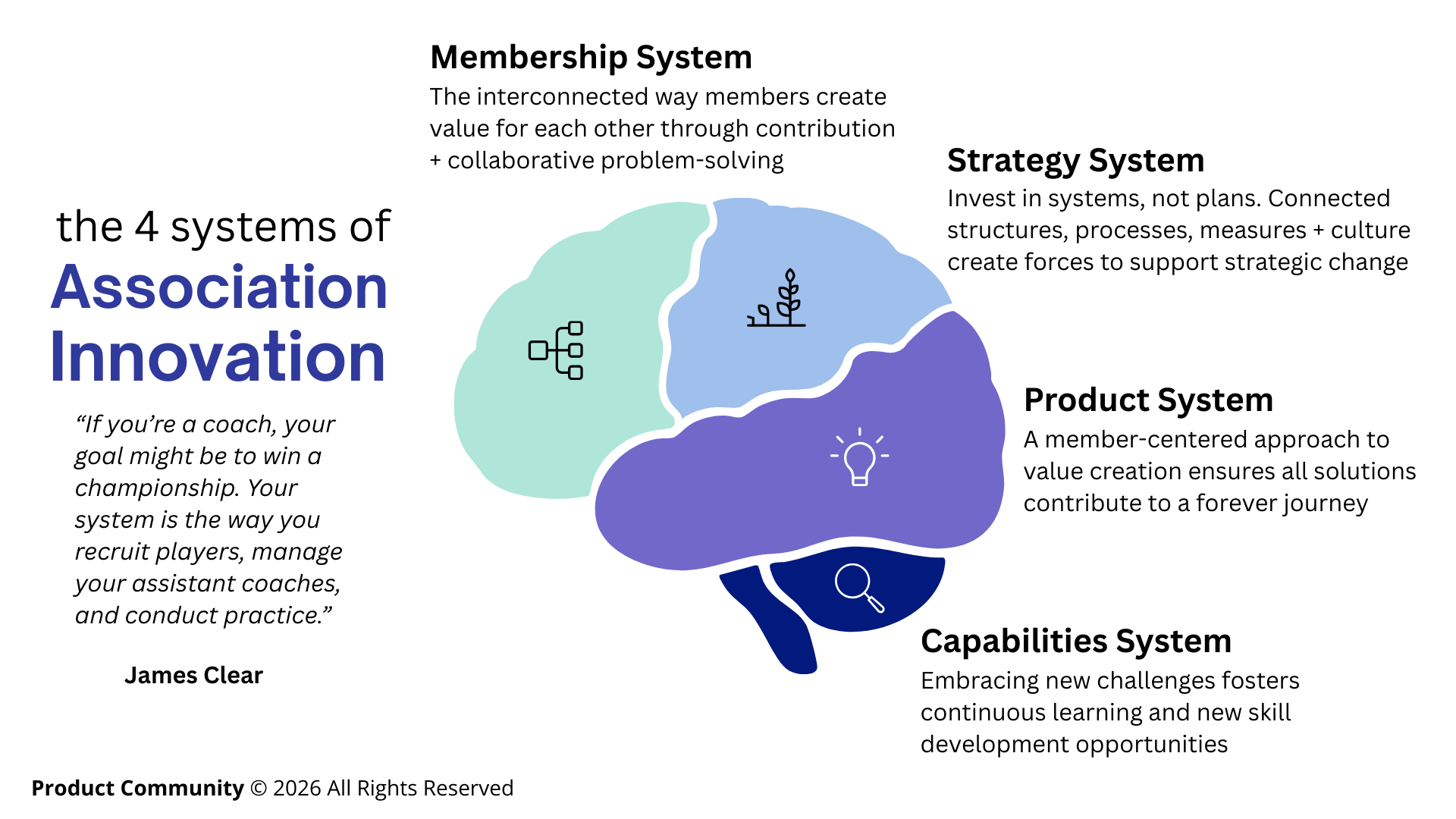
This is the foundation those systems rest on. If members show up as passive consumers waiting to be served, even the most elegantly designed product system will underperform. But if membership is itself a system — one where contribution is the default, where every member is both a beneficiary and a source of value — then every other system we build gains compounding power.
Adrian Röbke’s garden metaphor captures this precisely. A garden doesn’t depend on a single source of energy or a single gardener making all the decisions. It thrives because its many living parts interact: root systems share nutrients, pollinators move between plants, decomposition feeds new growth. The gardener’s job is not to produce the value; it’s to create the conditions under which diverse, living things produce value together.
That’s the design shift. When an association operates like a garden, membership becomes something to be cultivated. New members aren’t handed a benefits checklist, they’re planted into existing conversations and projects where their fresh perspective adds immediate value. Content isn’t created in isolation and broadcast out, it’s developed through member collaboration, ensuring relevance while building ownership. Success isn’t measured by renewal rates alone, it’s tracked through the health of member-to-member connections, contribution patterns, and value creation cycles. The system learns and adapts based on actual member behavior rather than assumptions about what they want.
Skin in the Game: Designing for Contribution
“Most long term successful careers, relationships and lives are built not just on hard work, perseverance, discipline, forgiveness and resilience but also trust and integrity. Trust enables speed and enables people to take risks on those they trust.”
Rishad Tobaccowala
The garden metaphor only works if members actually participate in growing it. This requires what I call skin-in-the-game contribution: members must have something at stake — reputation, relationships, shared outcomes — that makes their participation meaningful rather than optional.
This is not a call for volunteerism or committee service. It’s a design principle. The question isn’t how do we get members to do more? but how do we structure the system so that even small acts of participation create visible ripples of value?
Consider the difference. In a traditional model, a member attends a webinar. They consume content. The interaction ends. In a contributory system, that same member attends a working session where they bring a real challenge they’re facing. Peers with relevant experience weigh in. The resulting conversation generates a solution the original member can apply and a case study that enriches the community for the next person who encounters a similar problem. The member simply participated in a structure designed to turn participation into shared value.
This works at every scale. A member answering a peer’s question in a discussion forum is contributing. A member sharing a resource they found useful is contributing. A member presenting a failed experiment at a peer learning session is contributing. The system’s job is to make these contributions visible, connected, and cumulative so that members see themselves not as consumers of an association’s output but as essential nodes in a living network.
The design structures that enable this aren’t complicated, but they are intentional. They include visible contribution tracking that shows members the impact of their participation. They include peer matching that connects people around shared challenges rather than shared job titles. They include feedback loops that route real-world application stories back into the learning ecosystem so that knowledge isn’t consumed and forgotten but tested, refined, and recirculated.
When members see their contributions creating value for others, something shifts. They stop evaluating membership on a cost-benefit spreadsheet and start experiencing it as a relationship with a community they’ve helped build. That shift — from consumer to co-creator — is where the compound returns begin.
The Career Lifecycle as a Self-Balancing System
“Participatory processes, membership, and governance models — those that blur the lines between insider and outsiders — should be prioritized over managerial approaches that concentrate control and decision-making.”
Pete Davis
One of the most persistent problems in the association world is the lifecycle gap. Traditional associations serve primarily mid-career professionals who eventually age out without adequate replacement. Young professionals resist joining because of the creaky value proposition — pay dues, receive content — doesn’t compete with what’s freely available. Senior professionals drift away when they feel they’ve outgrown what the association offers. A membership system resolves this naturally, because different career stages contribute different things.
Early-career professionals bring questions, energy, and a willingness to experiment. Their challenges are fresh and urgent: how to navigate a first leadership role, how to apply emerging tools, how to build a professional identity. These questions don’t drain the system; they fuel it. They create the demand that gives mid-career and senior members a reason to engage.
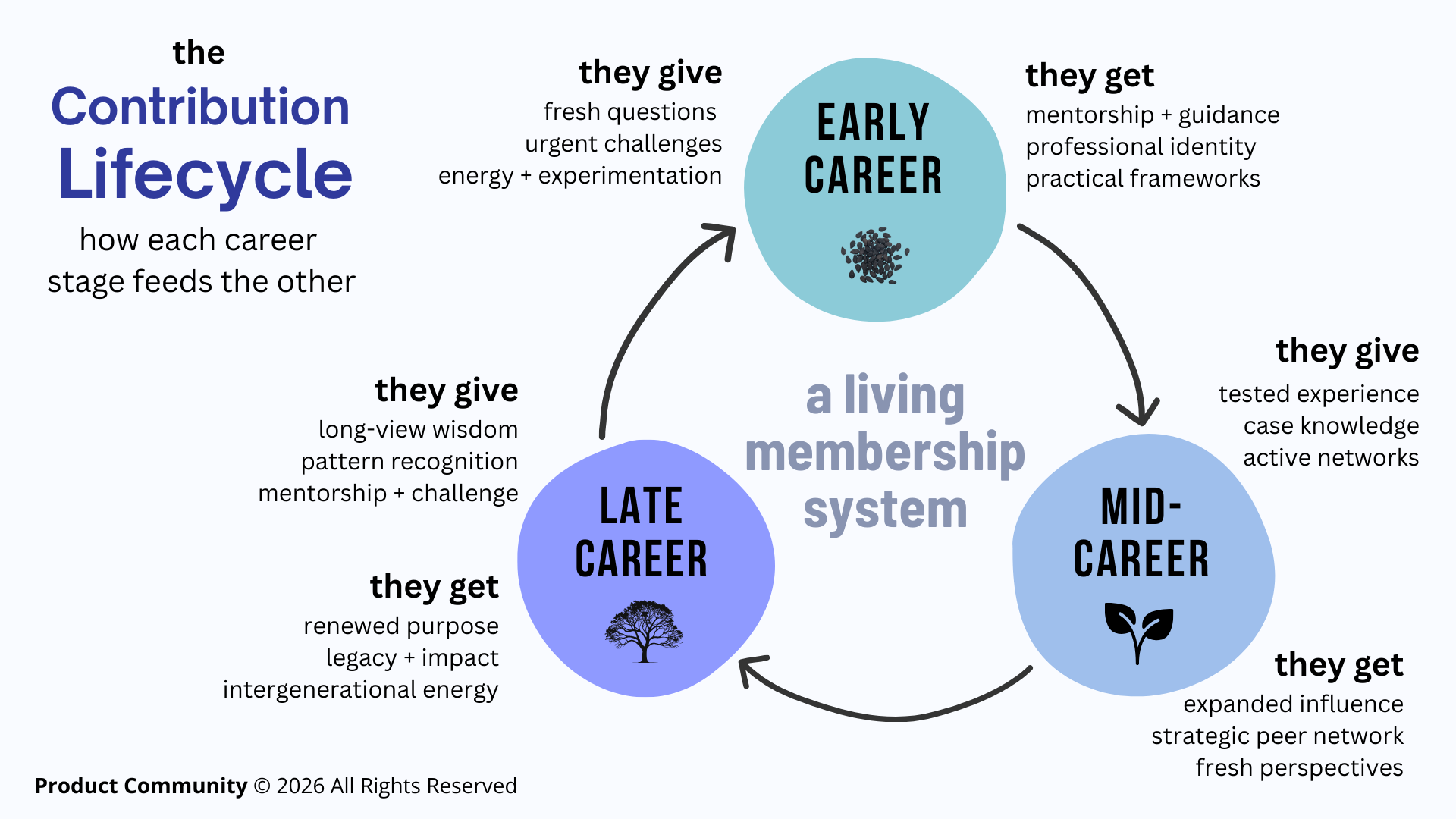
Mid-career professionals bring hard-won experience and expanding networks. They’re in the thick of implementation: managing teams, navigating politics, making important decisions. When they share what’s working and what isn’t, they generate the practical case knowledge that helps make the community indispensable. In a contributory system, their participation deepens their own networks while building the social infrastructure that holds the community together.
Senior professionals bring perspective, pattern recognition, and the desire for renewed purpose. Many have aged out of traditional association programming: they’ve attended the conferences, earned the certifications, sat on the committees. But in a membership system, their expertise finds new expression through mentorship, by challenging the assumptions of less experienced members, and through contributing the long-view wisdom that helps us avoid repeating our mistakes.
The key insight is that each stage both gives and receives, but gives and receives different things. The system self-balances because it’s designed around complementary needs rather than uniform benefits. Members at different career stages don’t need the same things. This is good as gardens thrive on biodiversity, so does a membership system.
This is where the connection to capabilities systems becomes concrete. An association that can facilitate multi-generational value exchange possesses a differentiated capability that competitors (free webinar platforms, the LinkedIn groups, the one-off course providers) simply cannot replicate. As a living ecosystem that must be cultivated over time, the value provided cannot be copied.
Criteria for Making the Leap
“Systems thinking is a discipline for seeing wholes. It is a framework for seeing interrelationships rather than things, for seeing ‘patterns of change’ rather than ‘static snapshots.’”
Peter Senge
Not every association is ready for this shift and pretending otherwise leads to expensive false starts. Based on the systems design principles I’ve outlined previously, three critical criteria must be in place.

Leadership Commitment to Long-Term Thinking. The board and senior staff must understand that a membership system generates compound returns, not quick wins. Leaders must be willing to measure success differently: tracking member-to-member connections, contribution patterns, and value creation cycles rather than just renewal rates and event attendance. This shift demands courage to abandon comfortable but outdated models that focus on short-term revenue.
Organizational Capacity for Integration. I’ve written about cross-functional collaboration as an essential element of product systems, and it’s equally essential here. Marketing, membership, events, education, and technology teams must coordinate rather than operate as silos. A membership system tracks journeys across touch points, enables peer-to-peer interaction, and facilitates collaborative value creation. If departments won’t coordinate, the system approach will fail.
Member Readiness for Participation. Membership must include enough people willing and able to contribute, not just consume. Look for members who ask questions in educational sessions, volunteer for committees, share resources, or mentor others. These participants become the foundation for the contributory culture essential to a membership system. If your membership consists primarily of passive consumers who resist engagement, you’ll need to gradually shift this culture before attempting a full systems approach.
There are a slew of questions to help craft the journey: Do our leaders measure success beyond traditional metrics and support experimental approaches? Can our staff coordinate across departments to create integrated member experiences? Do we have a core group of members who actively participate and contribute to peer learning? Are we willing to invest 18-24 months in building system infrastructure before expecting significant returns? Can we resist the urge to revert to traditional approaches during inevitable transition challenges?
Associations that can answer yes to these questions are positioned to make the leap.
The Compound Return
“An audience is a community. The published word is a declaration of membership in that community and also of a willingness to contribute something meaningful to it.”
Atul Gawande
The financial and strategic case for membership as a system connects directly to the value ladders and revenue diversification I’ve explored previously. But the mechanism is different. Thought leadership creates revenue through integrated offerings. A membership system creates the fertile ground that makes those offerings work because members who see themselves as contributors engage more deeply, stay longer, and attract others.
Associations that continue to operate on the benefits paradigm will find themselves in an increasingly difficult position. They’ll compete on price with free alternatives. They’ll struggle to demonstrate ROI on intangible benefits. They’ll watch their most engaged members drift away to communities that offer genuine participation and co-creation.
When we understand membership as a system, we stop asking what can we give our members? and start asking how can we enable our members to create value together? This shift — from distribution to facilitation, from content to connection, from benefits to belonging — transforms how associations operate and why they exist.
The path forward requires courage to abandon comfortable, but outdated models. It requires patience to build systems that generate compound rather than immediate returns. Most of all, it requires faith in our members’ ability and desire to contribute to something larger than themselves. But for associations willing to make this shift, the reward is sustainable relevance in a world where traditional membership models are rapidly becoming obsolete.
I lead the product community; we are a learning community because we believe great relationships help us create the value our members want. Remember, product-led growth fuels connection. Join the product community and flip your destiny.
About the Author
James Young is founder and chief learning officer of the product community®. Jim is an engaging trainer and leading thinker in the worlds of associations, learning communities, and product development. Prior to starting the product community®, Jim served as Chief Learning Officer at both the American College of Chest Physicians and the Society of College and University Planning. Please contact me for a conversation: james@productcommunity.us