
The Seamless Member Experience
Using Service Design Principles to Earn Deep Connection and Forever Loyalty

Summary
Service design is a holistic, org-wide approach to creating and improving service. It focuses on the entire ecosystem of people, processes, touch points, and systems that deliver value to members. It goes beyond fixing individual problems to orchestrating how all elements of service work together across time and channels.

This is an article about design, not software. Design is an investment in understanding, empathizing with, and serving members across the lifecycle. It emphasizes building relationships so we can anticipate needs, earn trust, and grow connection. Over time, we are in tune with members whose expectations evolve from consuming benefits to contributing meaningfully to a thriving community.
I lead the product community, a product development learning community designed specifically for associations. Let’s compare ideas and build something great.
What is Service Design?
“When businesses shape products and experiences around deep customer understanding – removing friction, solving unarticulated problems, creating moments that feel personally designed – something accumulates beyond satisfaction. They feel understood. They experience small moments of delight. They integrate the brand into their identity because it reflects how they see themselves or want to be seen.”
Paul Worthington
We all know when something is well-designed. It feels so natural that we don’t have to think. It makes life easier, reduces stress, and allows us to focus on what’s important: making connections, contributing ideas, and experiencing meaning.
Unlike traditional design that might focus on a single product or interface, service design considers the entire member journey: from how one initially discovers us through every succeeding interaction. It maps both the visible frontstage experiences members see and the invisible backstage infrastructure that enable and make those experiences come alive.
Think of it as choreographing a performance where technology, people, physical spaces, and digital touch points all work in harmony. Service design considers questions like: How does the online registration system connect to staff availability? What happens when a member’s needs evolve over time? How do different departments coordinate to deliver seamless handoffs?
Most associations are organized by departmental silo: membership, events, learning, advocacy, technology, marketing, etc. But members don’t think in buckets. They have baseline expectations that are seldom met: to experience value as a continuous flow. When associations apply service design principles, we emphasize coherence, continuity, and compound value. Service design is essential because:
Complexity demands alignment. Services span multiple channels, departments, and stakeholders.
New expectations. People compare every service to their best service experience elsewhere.
Hidden inefficiencies multiply. Poor backstage coordination creates exponential friction and frustration for members.
Moments accumulate. Individual interactions compound into overall perception.
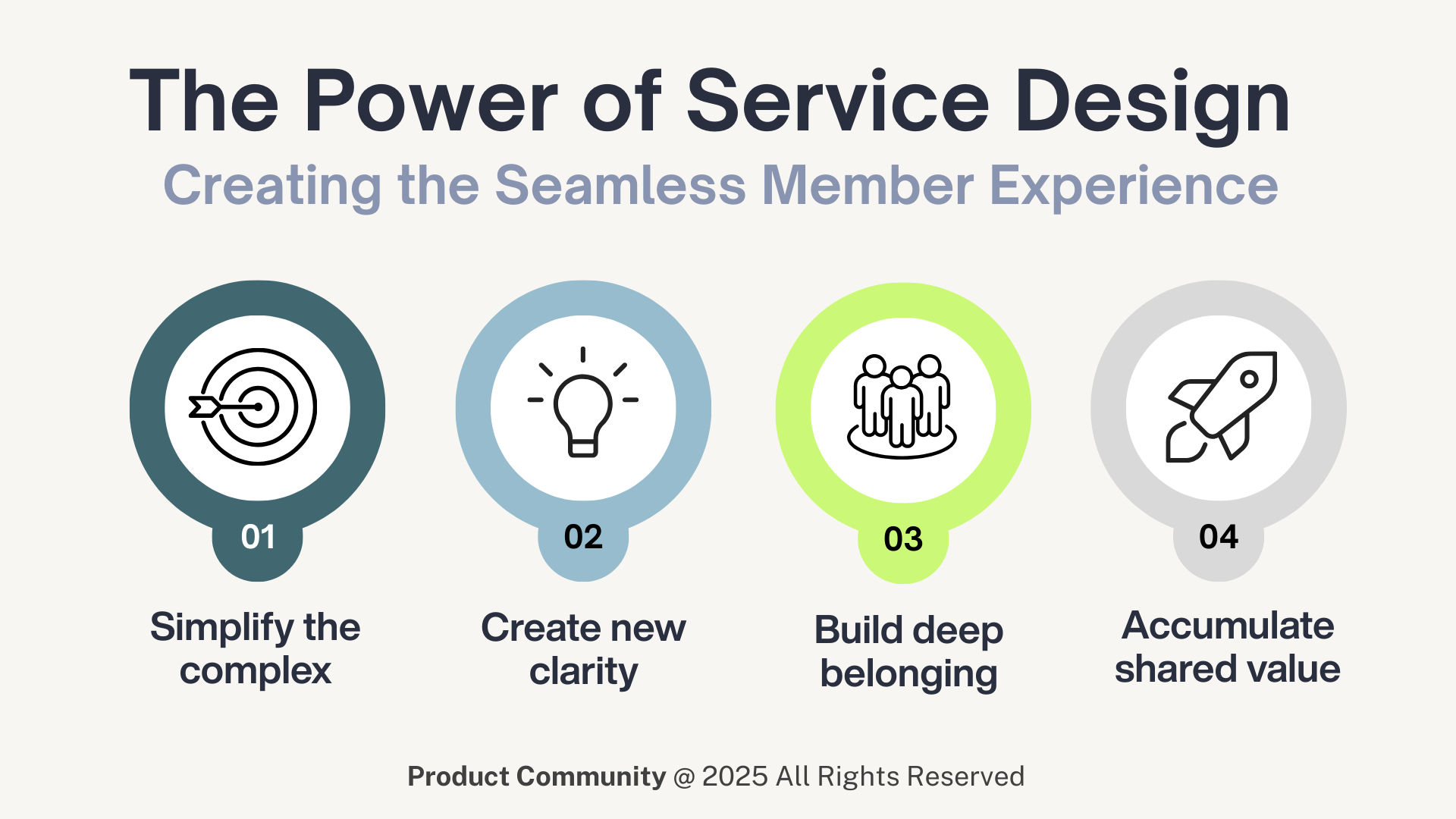
Service design can transform transactional, impersonal membership into the ultimate community experience. Instead of episodic value delivery through events and publications, service design builds continuous value creation where each interaction builds on the last, creating the compound effects that helps members grow into a thriving community.
How it Works in Practice | A Case Study
“Every iconic product, every delightful service, every meaningful brand exists because some group of people, somewhere, was a little bit obsessed.”
Kartikey Sengar
Service design is designing for belonging, where the whole becomes exponentially greater than its parts. Let’s look at how a fictitious association can evolve from clunky to seamless.
The Green Business Alliance operated like most associations: well-intentioned but fragmented. Marketing promises networking and resources, membership sells exclusive benefits, events planned conferences without knowing who attended last year’s webinars, and the volunteer coordinator had no idea which new members had expertise to share.
Sarah, who runs a sustainable packaging startup, discovered the Green Business Alliance by searching Google. She downloaded a white paper (entering her email into system #1), attended a virtual event (registering in system #2), then received generic membership pitches that ignored her previous engagement.
When she finally joined, she received a welcome packet listing 24 different benefits; it felt overwhelming and cold. The volunteer application was buried on page 12. Her attempt to update her expertise required emailing three different departments. Six months later, despite initial enthusiasm, Sarah was essentially dormant, another member in name only.
Software is part of the solution, but service design (the end-to-end consideration of the holistic member experience) came first. In this way, the Green Business Alliance reimagined their ecosystem through service design, creating the Green Growth Journey, a seamless progression from curious visitor to active community contributor. The shift is real.
Discover: Responsive First Touch
Now when Sarah experiences the Green Business Alliance through social media, search, or referral she encounters a simple question: What’s your biggest green business challenge? Her answer triggers a personalized pathway. Selecting sustainable supply chain immediately surfaces relevant content, connects her to a micro-community of peers facing similar challenges, and invites her to a focused virtual roundtable.
This happens before membership is even mentioned. The system remembers everything; each interaction builds her profile, not in a creepy surveillance way, but transparently: “Based on your interest in supply chain sustainability, you might value...”
Join: Context and Confidence
Instead of a generic Join Now button, Sarah sees “Continue Your Green Growth Journey.“ The membership process acknowledges her history: “Sarah, you’ve already engaged with three supply chain resources and connected with two peers. Membership unlocks deeper collaboration tools and expert guidance.”
The application process is responsive: basic info first, then optional enrichment. It pulls forward her previous interactions: “We noticed you downloaded our Supplier Scorecard template. Would you like to join our Sustainable Supply Chain working group?” The value proposition is specific to her journey, not generic benefits.
Onboard: Orchestrated Activation
Sarah’s first member experience is a personalized dashboard showing:
Her next recommended action based on her challenge
Three peers who recently solved similar problems
An upcoming session specifically relevant to her needs
A simple prompt: “Share your expertise in packaging innovation?”
Each element connects. Accepting the volunteer prompt automatically adds her to the speaker pool for relevant events, triggers an invitation to mentor newer members, and flags her expertise for other members seeking packaging advice.
Engage: Seamless Value Creation
The traditional model had Sarah navigating separate systems for events, learning, and networking. Now, attending a workshop automatically:
Updates her learning pathway
Suggests follow-up resources
Connects her with other attendees
Triggers relevant volunteer opportunities
Adds accomplishments to her visible member profile
When Sarah purchases advanced certification courses, the system adjusts her entire experience. She’s invited to teach introductory sessions, matched with study partners, and given access to implementation communities.
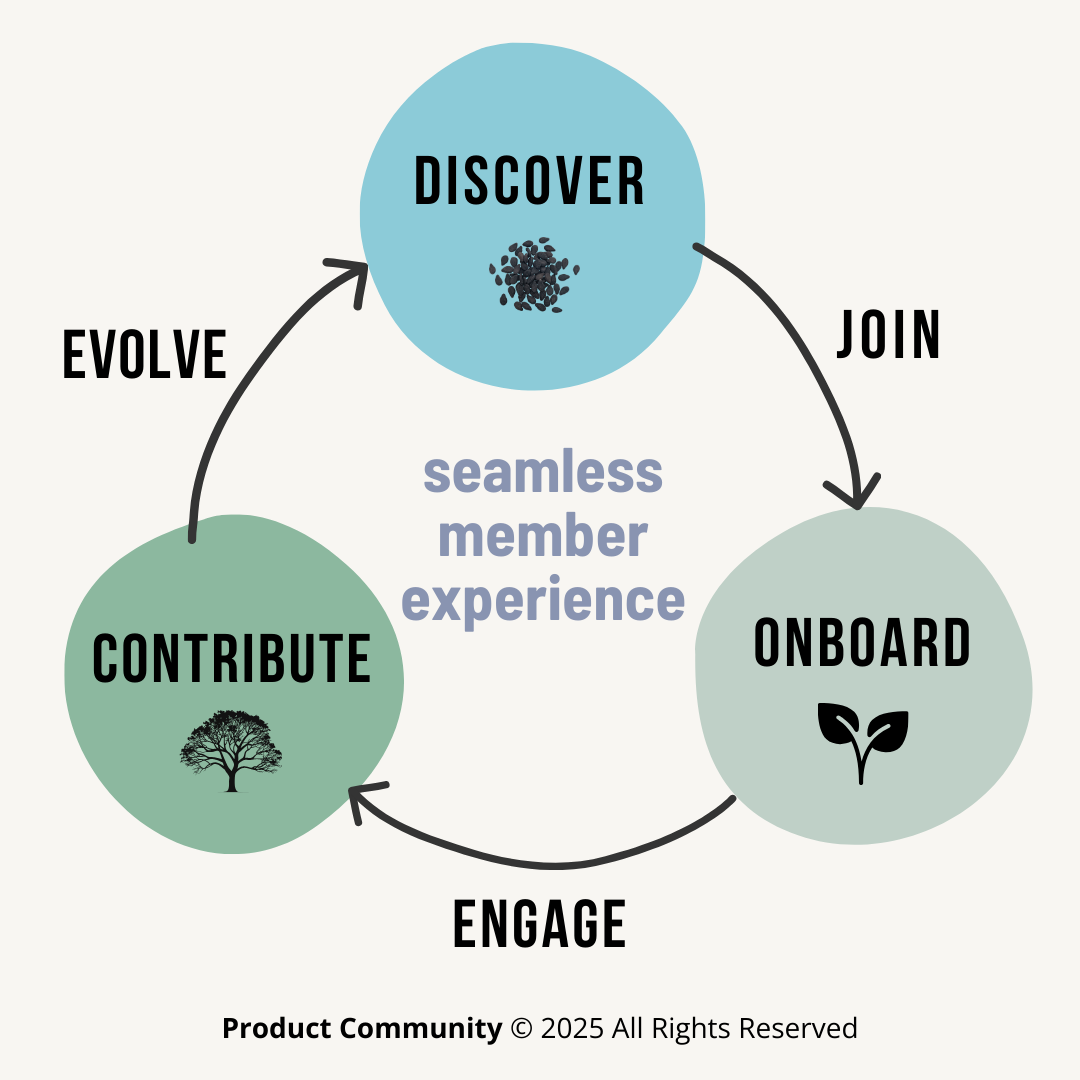
Contribute: Frictionless Participation
The Green Business Alliance investment in service design brings active participation to the forefront. When Sarah answers a peer’s question in the forum, she’s automatically suggested as a quick advisor for similar challenges. Her availability calendar syncs whether she’s volunteering, attending, or presenting.
The volunteer experience is also transformed. Instead of filling out applications and waiting, Sarah sees real-time needs matched to her expertise: “Three members seeking 15-minute packaging consultations this week.” One click schedules them all. Her contributions are tracked, celebrated, and connected building her reputation and relationships simultaneously.
Evolving: Pathway Progression
Unlike the old model where five-year members had essentially the same experience as first-year members, Sarah’s journey evolves. The system recognizes her growing expertise and automatically:
Elevates her visibility as a packaging expert
Invites her to shape new initiatives
Connects her with partnership opportunities
Suggests leadership positions aligned with her demonstrated interests
Her member dashboard transforms from “learning and connecting” to “leading and creating.” The difference is expressed not in magic software, but in an association that has invested in service design. Done well, organizations see transformative results:
Enhanced Member Experience: Services feel intuitive and cohesive rather than fragmented. Members don’t have to reorient themselves at each touchpoint or repeat information across departments. The experience anticipates needs and removes friction before it becomes visible.
Operational Efficiency: By mapping end-to-end processes, organizations discover redundancies, gaps, and misalignments. What often surprises leaders is how much waste exists in the handoffs and translations between departments.
Innovation Clarity: Service design reveals where strategic changes could transform value delivery. It helps distinguish between fixing symptoms and addressing root causes.
Organizational Alignment: Service design creates a shared language and vision across silos. When everyone can see how their work connects to the member journey, collaboration becomes purposeful rather than mandated.
Sustainable Differentiation: Well-designed services create moats of excellence that competitors can’t easily replicate. Instead of service bloat, value is enhanced when everything works together.
We have all experienced something well-designed. It’s smooth, painless, and anticipatory. A service-designed experience creates something traditional models cannot: deep and abiding trust. Sarah doesn’t have to wonder if she’s missing something, figure out how to engage, or justify her membership. Her association demonstrates its value through seamless experiences that consistently delivers results.
Trust as the Ultimate Outcome
“The real strength of a network isn’t in its size. It’s in the quality of its relationships. In other words, without connection, no strategy sticks. But, when people feel seen, heard and valued, trust grows. And trust enables learning, action and innovation. So, move at the speed of trust, not the speed of getting things done.”
Adrian Röbke
We’re not going to feel connected if we’re not cared for. If we don’t feel connected, noticed, or properly served, we’re going to take our business elsewhere. The association’s unique value proposition hinges upon robust community. To achieve this high-bar, we need end-to-end service design.
With service design, members stop asking “What do I get?” and start wondering “How can I contribute?” Over time, we evolve from a benefits-centric vendor to a thriving community focused on value creation and shared growth.

Members like Sarah become evangelists because she’s experienced a human-centered, integrated journey that makes active participation and peer engagement the obvious path forward. In this way, we move well beyond membership to creating a community catalyst whose value compounds over time.
Great service design means we understand and care about our members enough to provide great experiences. It means we invest in systemic excellence. Over time, we transform our culture to make traditional membership look archaic by comparison.
I lead the product community; we are a learning community because we believe great relationships help us create the value our members want. Remember, product-led growth fuels connection. Join the product community and flip your destiny.
About the Author
James Young is founder and chief learning officer of the product community®. Jim is an engaging trainer and leading thinker in the worlds of associations, learning communities, and product development. Prior to starting the product community®, Jim served as Chief Learning Officer at both the American College of Chest Physicians and the Society of College and University Planning. Please contact me for a conversation: james@productcommunity.us