
Reading Member Rhythms
Learning About, From, and With the People We Serve

Summary
How well do we know our members? We survey, track conference attendance, monitor renewal rates, and read the comments on satisfaction forms. And yet, when a long-tenured member quietly doesn’t renew, a program launches to tepid response, or a strategic initiative fails to resonate, we are surprised. The data says one thing, but members do another.
The gap between what we think we know and what is true about our members’ professional lives is a central challenge of association leadership. Closing that gap is a proximity problem. How close we get to the people we serve determines what we learn about them. And what we learn determines how we engage and serve them. Everything else follows.
I lead the product community, a product development learning community designed specifically for associations. Let’s compare ideas and build something great.
The Peril of Passivity
“We love passive formats because they are low-friction.”
Carl Hendrick
Simple insights can belie the truth. What we understand about members often comes from what they tell us when we ask directly: what did you like about the conference, would you recommend membership to a colleague, how satisfied were you with the webinar. This data is real, but it is also limited: it only captures what members can articulate, in the moment we ask, about experiences we already delivered.
It tells us almost nothing about the career anxiety they feel, the problem they searched for but couldn’t find help with, the reason they almost didn’t renew, or the thing they’re trying to accomplish that we’ve never thought to offer.
Surveys and feedback forms measure the surface of the member experience. They are trailing indicators, built on memory and shaped by social desirability (saying what seems reasonable rather than the truth). They confirm what we believe more than reveal what we are missing.
Surveys are important, but imperfect tools. Understanding this helps us chart a path to truly understanding our members. There is a whole world of untapped member experience that exists below what people can easily articulate. This world becomes accessible when we empathize with their day-to-day professional lives. This entails thinking differently about how we collect data about, from, and with our members.
A Spectrum of Proximity
“This is the exact moment that calls for collective continuous improvement. Learning together, experimenting safely, sharing what works, iterating on how the team operates.”
John Cutler
The ways we learn about members can be plotted on a proximity spectrum. At one end (passive, low proximity) are methods that gather information at scale, from a distance. At the other end (active, high proximity) are more primary, direct methods that place us alongside members and provide us richer, more in-depth insights.. Both ends are useful and have value, but most associations reside exclusively at the low-proximity end and, therefore, mistake the scale of their data collection and ease of interpretation for depth of our understanding. The spectrum has five distinct modes of engagement.
Ask at Scale. Annual surveys, pulse surveys, renewal feedback forms, and content ratings all belong here. These tools are familiar and efficient allowing us to gather responses from a lot of members quickly. Used well, they can surface statistical patterns and track trends over time. Used poorly, they generate reports that confirm existing assumptions. The limitation is often in the interpretation; what members articulate in a survey is a fraction of what they know. And what they know about their needs is only a fraction of what’s actually driving their behavior.

Ask in Depth. Empathy interviews, focus groups, exit interviews, and Net Promoter Score follow-up calls nudge us closer. These conversations are qualitative and open-ended allowing members to tell stories rather than fill boxes. In an empathy interview, we move beyond “are you satisfied?” We are moving toward “walk me through the last time you needed help and didn’t know where to turn.” The response (with its texture, emotion, and context) can hold more strategic insight than a survey. Focus groups add the dimension of group dynamics, revealing tensions and shared frustrations. Exit interviews, when done with genuine curiosity, can elicit honesty and vulnerability. Leavers will tell you the truth that stayers often cannot.
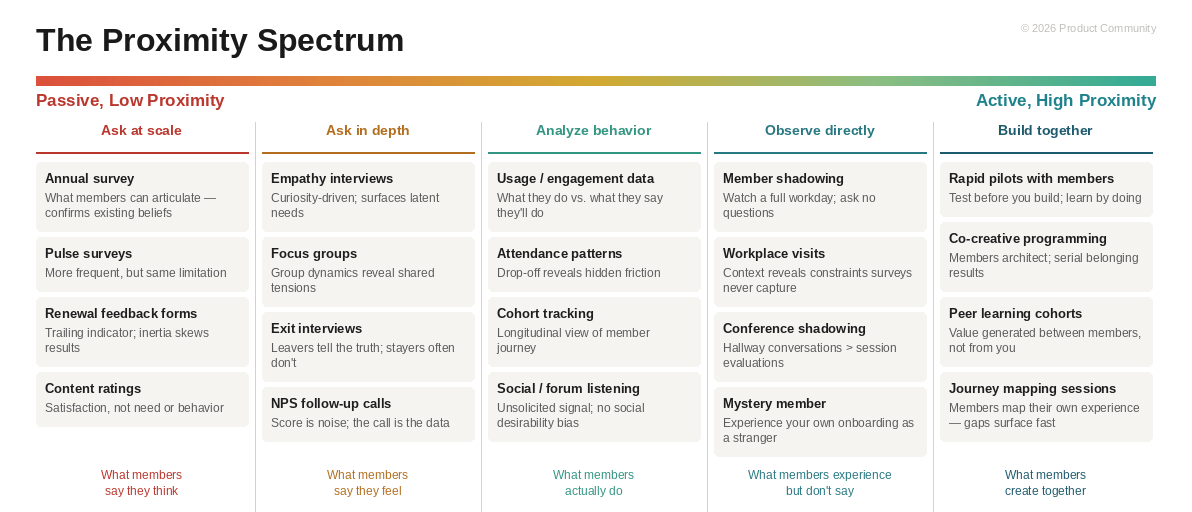
Analyze Behavior. Usage and engagement data, attendance patterns, cohort tracking, and social listening belong here. These methods are powerful because they bypass self-report entirely. You’re not asking members what they do, you’re watching. Attendance patterns reveal where your programming creates genuine pull and where members drop off. Cohort tracking allows you to follow groups of members longitudinally, watching how engagement evolves over time across career stages or entry years. Social listening surfaces the conversations members are having in forums and communities that were never meant for your eyes, the unfiltered, unsolicited signal of what they care about and struggle with. Behavioral data, combined with qualitative insight, is where the picture begins to come into full focus.
Observe Directly. Member shadowing, workplace visits, conference shadowing, and mystery member experiences move us deeper into the member’s world. When we spend a full workday alongside a member, we observe how they allocate time, where they feel pulled in competing directions, what a hard day actually looks like, and we encounter constraints that a survey would not surface. Context reveals what conversation conceals. Conference shadowing (listening to hallway conversations rather than session evaluations) captures the questions people are asking, the conversations that start at 10pm over a drink. These are the moments we rarely witness. The mystery member experience (going through our onboarding as a stranger would) can be a humbling exercise. What feels obvious to staff can feel opaque to members. Seeing our association through fresh eyes changes what we build.
Build Together. Rapid pilots with members, co-creative programming, peer learning cohorts, and journey mapping sessions represent the highest form of proximity: not studying members, but working alongside them. When members architect the experience (when they are co-designers rather than end users) two things happen simultaneously. The output is better, shaped by the expertise and context only they possess. And something deeper occurs: the member becomes invested in the outcome. Co-creation is not just a discovery method; it is a belonging mechanism. Members who help build something feel ownership over it. That ownership generates the kind of durable engagement no marketing campaign can manufacture.
The proximity spectrum exists to help us make choices. The goal is to learn from our members in a way that provides deep, ongoing, usable insights about their work rhythms and how they communicate, navigate complexity, and make decisions. We learn from data collection, outreach, observation, dialogue, experimentation, and co-creation. The through line that unites membership discovery is empathy.
The Empathy Imperative
“Optimal contact induces empathy.”
Eric Higbee
Moving toward higher-proximity methods is important, but not sufficient. Yes, it suggests deep empathy (a good thing) to make our methods more effective.
Empathy is a commitment to entering another person’s experience, setting aside our own assumptions to hear what they’re saying. In practice, this means sitting with a member’s frustration rather than immediately offering a solution. It means asking “tell me more about that” rather than nodding and moving on. It means being surprised when a member describes a need you hadn’t anticipated.
The opposite of empathy in member research is confirmation bias: going through the motions of discovery already knowing what we’re going to find. It shows up in interview questions that lead toward predetermined answers, focus groups where staff do most of the talking, and surveys designed to validate a program that’s already been approved for budget. Being curious about members gets different results than simply going through a compliance exercise.
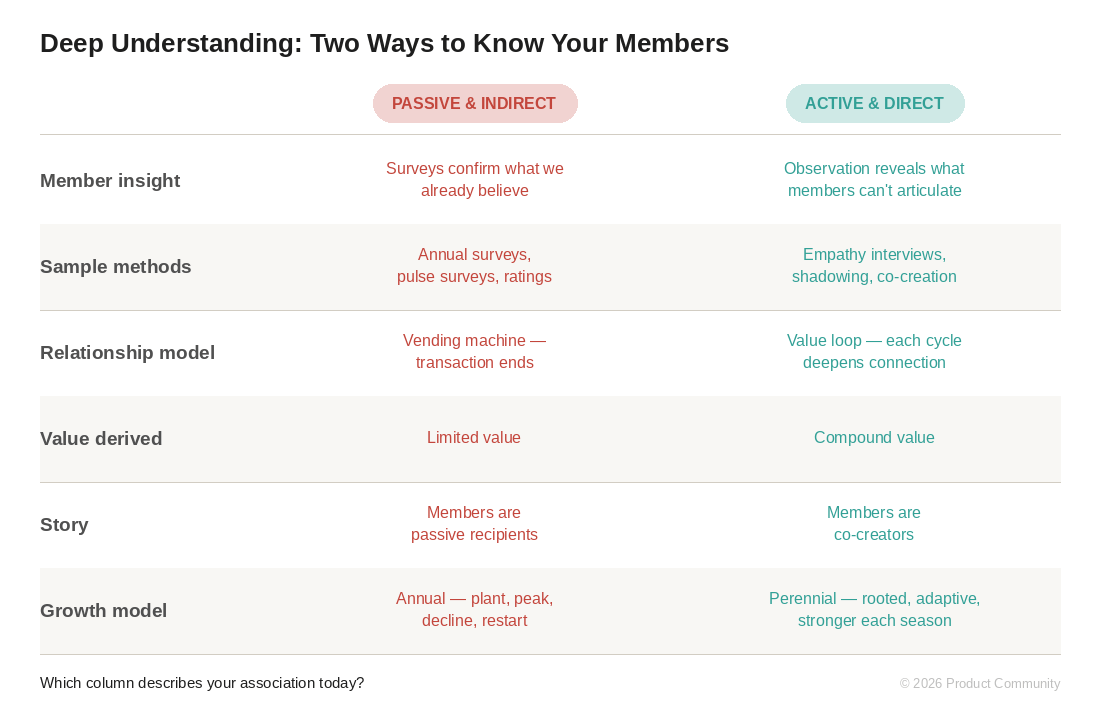
Consistency matters. A practice of continuous discovery (ongoing, embedded in the rhythms of organizational life) paints a rich collage of member patterns while we earn the important trust of ongoing outreach. Teresa Torres calls this continuous discovery: an organizational habit that keeps us in ongoing contact with member reality: weekly insight-sharing, monthly pattern-finding, quarterly experiments, annual recalibration. Associations that truly know their members find and leverage this rhythm.
There is a temptation to focus solely on the right side of the proximity spectrum. More co-creation and shadowing, fewer surveys. This is a mistake. A well-designed member discovery practice uses three or four methods from across the spectrum in combination. Why? Because each mode reveals a different layer of truth.
Surveys tell us that satisfaction scores dipped after we changed our conference format. The empathy interview tells us why: a member describes feeling like hallway time was sacrificed for more content. The attendance data shows us the sessions where drop-off spiked. The follow-up conversation with a member who helped design last year’s format reveals that the change was made without consulting the people most invested in the experience. Each layer requires a different method. No single tool gives you the full picture.
Think of it as triangulation. Quantitative data provides scale and pattern; qualitative conversation provides meaning and context. Behavioral observation gives us truth uncorrupted by self-report. Co-creation provides ownership and innovation. The richest member intelligence comes from utilizing all four simultaneously and from knowing which question each method is best suited to answer.
Proximity Builds Community
“Community thrives on energy, relationships, and discovery. People come to forums, events, and member programs to connect with others like them. They want to see how their peers solve problems and apply tools in the real world.”
Joshua Zerkel
Getting to know our members helps us build relationships, connect people, and grow our community.
When a member participates in a co-creative workshop and watches their idea become a program, they stop being a consumer and become a contributor. When a member is interviewed with real curiosity (when they feel genuinely heard) the relationship changes. When a member sees that we showed up to shadow them at their workplace, the signal is unmistakable: you matter enough for us to come to you.
This is what transforms us from professional services vendors into a community: a place where people feel seen, known, and connected to something larger than themselves. The proximity spectrum is a relationship-building framework. Every point of contact (interview, shadowed conference hallway, co-designed program) is an act of building insight, trust, and community.

Giving attention to the warmth of building relationships which helps us frame the impersonal chilliness of artificial intelligence. It means knowing our members well enough to show up at the right moment with the right value. These members say, unprompted: they actually get me, I feel like I belong here.
Understanding requires proximity, empathy, and consistency. Get closer.
I lead the product community; we are a learning community because we believe great relationships help us create the value our members want. Remember, product-led growth fuels connection. Join the product community and flip your destiny.
About the Author
James Young is founder and chief learning officer of product community®. Jim is an engaging trainer and leading thinker in the worlds of associations, learning communities, and product development. Prior to starting product community®, Jim served as Chief Learning Officer at both the American College of Chest Physicians and the Society of College and University Planning. Please contact me for a conversation: james@productcommunity.us