
The Member Journey Map
Understanding professional rhythms, experiences, and engagement patterns so we can solve member problems and create deep belonging

Summary
Members can be unpredictable. Despite our planning, they tend not to engage in clean and neat one-year progressions: join, attend events, take a course, renew, repeat. Their journeys are messier, reflecting the unpredictability of professional life. This requires us to know our members in new ways: to track their experiences, identify their problems, and anticipate their needs. Only then can we build the right value to create belonging and keep them coming back for more.
This is an article about member journey mapping. Evolving from a standard flowchart of touch points, we build visual narratives of what members feel, need, and struggle with across their professional lives. Properly designed, the map becomes an adaptive tool that connects continuous discovery (ongoing engagement that exposes patterns of behavior) to the fifty-year career journey (the arc of cumulative experiences).
I lead the product community, a product development learning community designed specifically for associations. Let’s compare ideas and build something great.
Journey Maps Are Rooted In Experiences
“When we shape products and experiences around deep customer understanding – removing friction, solving unarticulated problems, creating moments that feel personally designed – something accumulates beyond satisfaction.”
Paul Worthington
Traditional customer journey maps track what people do with your association: the steps, registrations, interactions, and touch points. They are useful, but they miss the fuller picture.
A member journey map, built as a genuine experience map, captures something more: the emotional context of members’ professional lives, including what’s happening when they’re not engaging with us. The career anxiety at 3am before a big presentation. The isolation of being the only person in the room who doesn’t know the unwritten rules. The inflection point when someone realizes they’ve outgrown their current role. These are the moments we were built to serve, but often miss the chance because we’re unaware of our members’ professional rhythms.
This matters because the moments of highest member need rarely align with our renewal cycle, annual conference, or content calendar. When we only track touch points we can see. A member journey map helps us see the member and that changes everything we build.
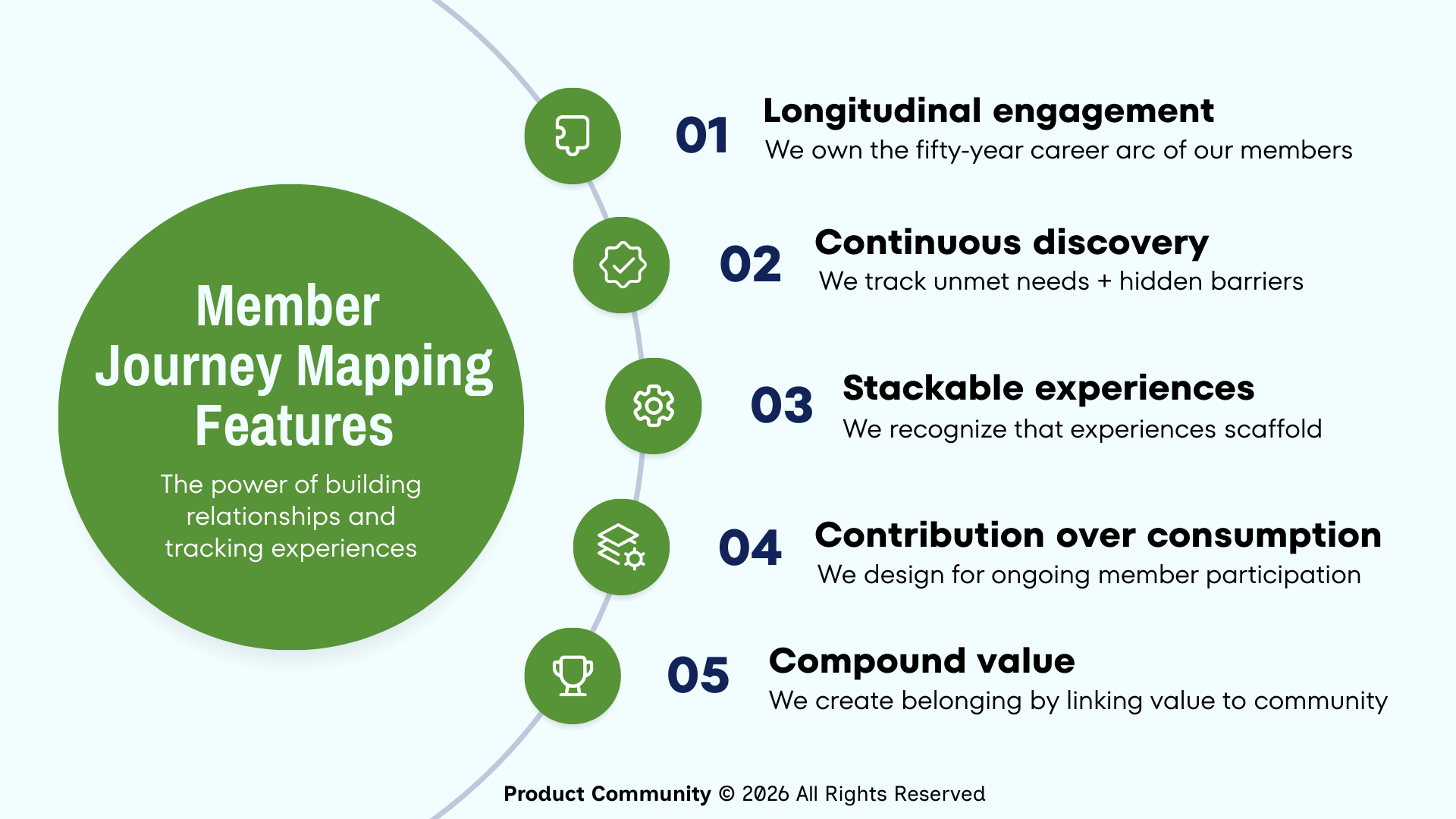
There’s also a revenue argument here. Traditional membership models monetize one decision point: join or don’t join. But professional lives don’t work that way. The same person who dismisses our association as irrelevant during a stable stretch of her career might desperately need peer support during a job transition, seek credential validation during a promotion cycle, and want to give back through mentorship after reaching a leadership milestone. Every one of those moments is an opportunity for value exchange.
What separates a member journey map from a one-time exercise is the commitment to the long view. As I’ve written in the Fifty-Year Career Journey, we have an enormous and largely unclaimed opportunity: to own the arc of a professional’s working life, from the early twenties through the early seventies. Not as a series of transactions, but as an integrated lifecycle ecosystem where each decade builds on the last and contribution grows alongside expertise.
A member journey map operationalizes that vision. It makes the fifty-year career journey visible, revealing the emotional peaks and valleys, the moments of acute need, the quiet periods, and the pivots that create new opportunities for your association to show up with relevant value.
The young professional managing imposter syndrome in her first role needs different things from the mid-career executive deciding whether to build internal credentials or seek industry recognition outside her company. The tenured leader shaping profession-wide standards needs different things from the wisdom-decade veteran trying to transfer fifty years of institutional memory before he retires. These are not the same member. A single membership package cannot serve all of them. A journey map reveals the full constellation.
This is what I mean by longitudinal engagement: not just retaining members longer, but designing experiences that compound in value as careers evolve so that each decade of membership is richer than the last, and the association becomes more indispensable as members grow.
Building the Map
“If you are new and unsteady, you are not behind. You are at the start of the only path that lasts. Build the map. Honor the risks. Collect the proofs.”
Alvis Ng
Start with the right team. Rather than a traditional committee, build a small and agile discovery trio:
Experience Owner (a program director or membership manager): Holds the strategic vision for member engagement
Member Experience Designer (communications or engagement lead): Focused on how members perceive and interact with the association
Implementation Lead (IT, operations, or platform): Understands what’s technically and operationally possible
The trio’s diversity is the point. What each person assumes about member experience will differ and those gaps are where insights hide.
Frame Your Guiding Question. The question shapes everything that follows, so invest in getting it right. “What prevents younger members from engaging meaningfully?” works because it focuses on a specific segment, explores barriers rather than assuming solutions, and opens space for discovering root causes. Other possible questions:
How do mid-career professionals decide whether our association is worth their time?
What triggers members to seek peer connections versus formal learning?
At what moments in a professional’s career are we absent and what does that cost them?
Conduct Empathy-Driven Discovery. Move beyond surveys into continuous discovery. Story-based interviews are the core engine here: ask members to walk you through specific moments: the last time they needed professional help, when they felt isolated at work, when they achieved a breakthrough, when they almost let their membership lapse. Listen for emotions and context, not just facts. The feelings are the data.
Supplement with shadow experiences: attend the networking events your target members attend, which may not be your annual gala. Observe how they build relationships. And use assumption mapping by having each trio member independently sketch what they believe members experience, then compare. The divergence between perspectives is where your most valuable discovery lives. The map itself should capture several layers simultaneously:
Trigger Moments. What makes a professional suddenly think, “I need help” or “I wish I knew someone who...”? These rarely coincide with renewal cycles.
The Consideration Swirl. Members weigh our value prop against LinkedIn groups, Slack communities, company training budgets, a mentor’s advice over coffee, and simply doing nothing. Understanding what wins (and when) is essential.
Peaks and Valleys. Where does energy and engagement spike (often during career transitions or moments of crisis) and where does it wane (often during stable stretches)? These patterns reveal when to show up and when to stay quiet.
Hidden Barriers. The blockers aren’t just price and time. They include fear of being the youngest person in the room, uncertainty about unwritten cultural norms, skepticism about ROI when someone is still building their career foundation, and the tension between company loyalty and profession loyalty. Surface these and you’ll find opportunities your competitors haven’t considered.
Teresa Torres is right: opportunities are not solutions. Your journey map should reveal patterns, not tell you what to build. Look for:
Moments of acute need where the association is absent
Emotional valleys where simple interventions could provide important value
Connection gaps between what members are trying to accomplish and what we offer
Timing mismatches where you show up too early or too late
These opportunity spaces become the basis for small experiments. If emerging professionals feel intimidated by formal networking, prototype a peer circles program. If mid-career members seek just-in-time learning during busy seasons, test micro-credentials or quick-hit workshops. If senior members want to leave a legacy, create impact projects they can lead. Each experiment generates learning that refines the map and surfaces the next round of opportunities. The key insight: we’re not building a product portfolio. We’re building a companion system: one that anticipates and meets members at different career inflection points with relevant, timely value.
Contribution Over Consumption: The Flywheel
“The job of a leader is to help people see how their contribution fits in with all the other people’s contributions to make something that no one would have been able to do alone.”
Casper ter Kuile
The most powerful thing a journey map reveals is where and when members are ready to contribute and where we’re leaving that value untapped.
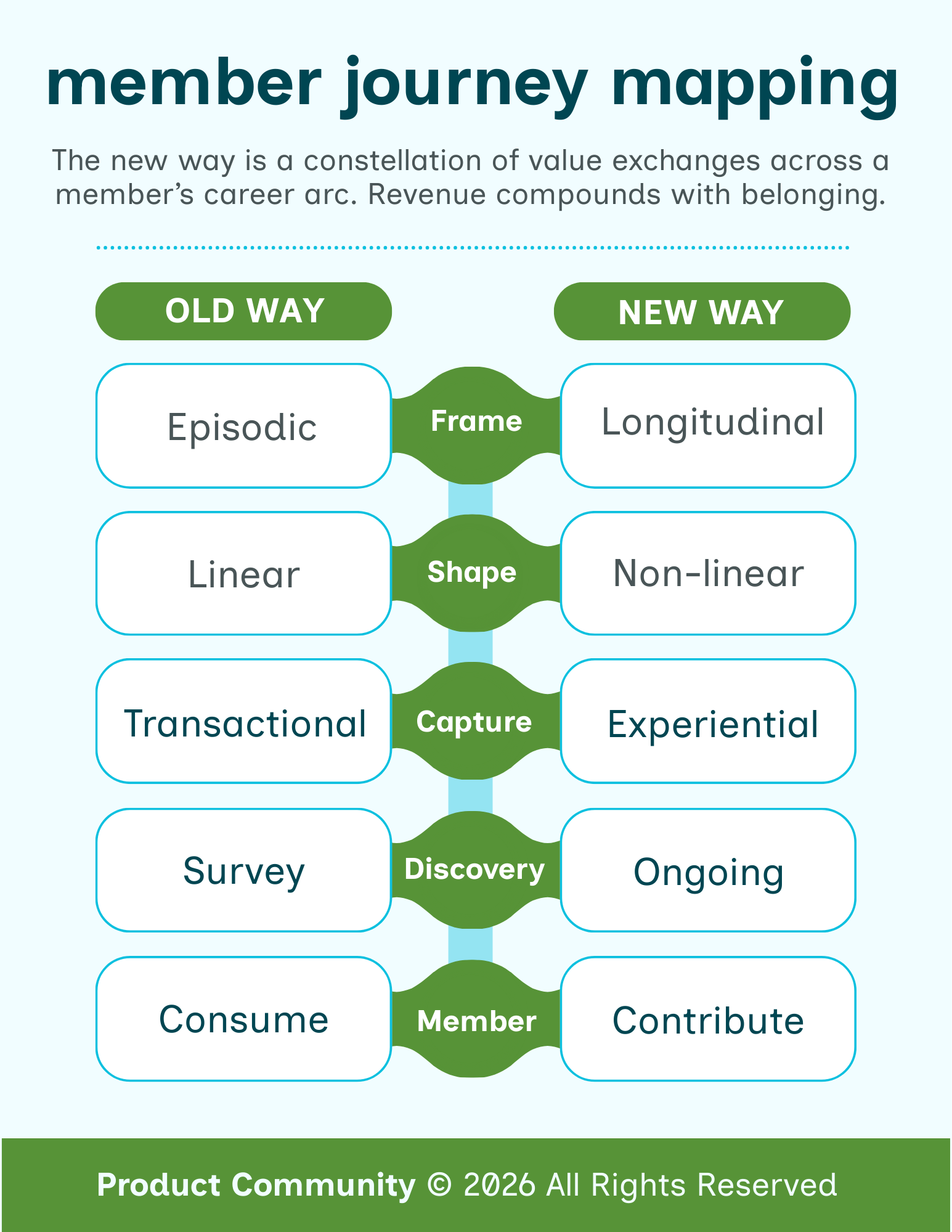
In the Continuous Member Journey, I described the transformation from consumer to co-creator as the defining shift toward indispensable community. A member who teaches a workshop is becoming more embedded in the association’s knowledge network, deepening her reputation, and building stakes in the community’s future. Other members benefit from her insights, but she benefits too. The exchange compounds. The journey map should be designed to surface these contribution opportunities at every career stage:
The Decade One professional with fresh academic training and digital fluency who can build content and energy for newer initiatives
The Decade Two expert who becomes a conference speaker and peer mentor while simultaneously refining her own thinking
The Decade Three authority who shapes association strategy and authors the research that defines professional standards
The Decade Four veteran who creates enduring frameworks and bridges generational knowledge gaps
The Decade Five wisdom-keeper whose oral history, pattern recognition, and long-term perspective prove invaluable during industry transitions
When the journey map makes these contribution pathways visible, we stop asking How do we get members to attend our events? and starts asking What role do we play in the professional lives they’re actually living? That shift — from association-centric to career-centric, from programs to experiences, from consumption to contribution — is what creates compound value. The journey map is not a one-time project. The transformation happens when it becomes a continuous discipline: a shared organizational rhythm rather than a document filed after a strategic planning retreat. Try these sustainable cadences:
Weekly: Each trio member brings one member insight from their natural interactions: a conversation, an email, a comment in a meeting
Monthly: Synthesize what you’re learning and update the map; look for patterns emerging across individual observations
Quarterly: Launch one small experiment based on current opportunity spaces; commit to learning from it regardless of outcome
Annually: Step back and review how the entire landscape has shifted: career stages, industry disruptions, competitive alternatives, member demographics
This is what I mean by continuous discovery: not a research project that produces a report, but an organizational capability that makes us progressively better at anticipating what members need before they know how to ask for it.
Revenue diversification follows naturally. When we deeply understand professional journeys, we stop trying to sell everyone the same membership and start building a portfolio of products that match different moments, needs, and career stages. Some members pay for intensive learning during transition periods. Others pay for credentials that signal expertise during promotion cycles. Still others pay for access to peer networks when isolation hits. And some pay to contribute their expertise back to the community which is itself a form of value exchange. Each cycle strengthens the next. The member journey map is the flywheel.
The Invitation
“Our search is never for a thing but for the feeling we think the thing will give us”
Jay Shetty
Associations are uniquely positioned to build something no other entity can: a lifelong career relationship grounded in community, expertise, and shared professional identity. However, our focus on the short-term, tactical, and operational leaves us in a bind. Episodic programming serves our calendar more than our member’s professional lives or career arcs.

The member journey map changes that. It aligns your team around a shared understanding of the lives your members are actually living. It reveals where you’re absent when you should be present. It shows you where contribution is waiting to happen. And it creates the foundation for compound value: engagement that grows richer and more indispensable with each passing year. Start with one guiding question. Build your discovery trio. Run one interview this week. The map will follow.
I lead the product community, a product development learning community designed specifically for associations. Let’s compare ideas and build something great. Remember, product-led growth fuels connection.
About the Author
James Young is founder and chief learning officer of the product community®. Jim is an engaging trainer and leading thinker in the worlds of associations, learning communities, and product development. Prior to starting the product community®, Jim served as Chief Learning Officer at both the American College of Chest Physicians and the Society of College and University Planning. Please contact me for a conversation: james@productcommunity.us