
Body of Knowledge
How to Organize Your Expertise | The Path from Authority to Thriving Community

Summary
Most of us are sitting on an extraordinary asset: the accumulated knowledge of our field, profession, or industry. We know what competent practice looks like and we know the frameworks, vocabulary, hard-won lessons, and trends. But in most associations, this knowledge lives in scattered places (conference sessions, journal archives, the heads of longtime members) rather than in a deliberate, organized, living structure.

A body of knowledge (BoK) changes that. It is a durable way to establish an association as an authoritative voice and it is the foundation for an expertise moat that competitors (training companies, universities, content platforms, even AI) cannot easily cross.
This article defines BoK, explores its uses, weighs the pros and cons, and makes the case for authority as competitive advantage. A BoK is ultimately a seedbed for community design, compound value, and diversified revenue.
I lead the product community, a product development learning community designed specifically for associations. Let’s compare ideas and build something great.
What Is a Body of Knowledge?
“The one sure source of lasting competitive advantage is knowledge.”
Ikujiro Nonaka
A BoK is the systematically organized, complete set of concepts, terms, frameworks, competencies, and accepted practices that constitute a profession or field. What does someone in this field need to know and how does that knowledge fit together?
Think of the Project Management Institute’s PMBOK® Guide, the software engineering SWEBOK, or the actuarial syllabi that define entire careers. These are architectures of expertise or deliberate maps of a domain that define its boundaries, organize its concepts, establish its vocabulary, and identify what competence means at every career stage.
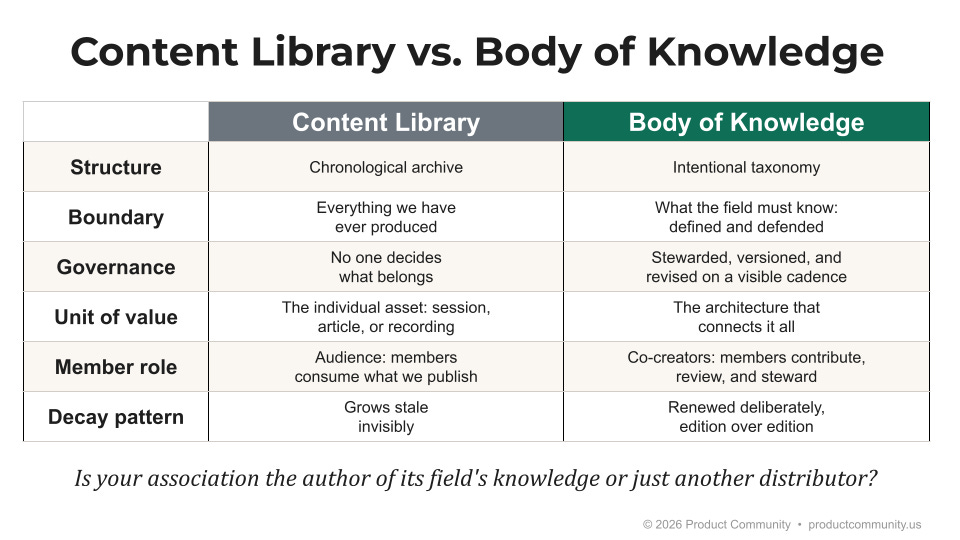
A content library is an accumulation; a BoK is an organization. We may have an inventory of thirty years of conference recordings, journal articles, and white papers. A BoK is the taxonomy, the connective structure, and the editorial judgment that transforms inventory into a coherent intellectual asset: one with named domains, defined competencies, versioned updates, and a governance process for deciding what belongs. Three characteristics distinguish a true BoK:
It is bounded. It declares what is inside the field and what is not. This act of definition is an act of authority.
It is structured. Concepts relate to one another in an intentional architecture (foundational to advanced, general to specialized) that mirrors how professionals develop over the fifty-year career journey.
It is governed and alive. Someone stewards it. It has versions. It evolves as the field evolves, through a visible, credible process of contribution and review.
A continuously co-created BoK is a versatile ecosystem. Once built, it becomes a load-bearing wall for nearly everything we do. Consider its uses:
Defining the profession. For emerging or fragmented fields, a BoK is an act of professional formation. It says: this is a discipline, with standards, and we are its stewards. For established fields, it defends the profession’s boundaries against dilution and commoditization.
Anchoring credentials and certification. Every defensible certification rests on a defined BoK. Without one, your exam is a quiz; with one, it is a professional standard. The BoK is what allows you to say, credibly, what a credential means.
Structuring education and pathways. A BoK converts scattered educational offerings into an intentional portfolio, a map with every course, workshop, and conference session. It exposes gaps, redundancies, and natural learning sequences, and it enables the longitudinal learning journeys that create durable engagement.
Onboarding the next generation. New entrants to a field face a wall of insider knowledge. A BoK makes the implicit explicit, shortening the path from novice to contributor and giving early-career professionals a concrete reason to engage.
Informing policy, standards, and public trust. When regulators, employers, media, and the public need to know what competent practice looks like, the association with the codified answer wields disproportionate influence.
Feeding everything downstream. Research agendas, publications, awards criteria, job task analyses, employer competency models, mentoring frameworks all draw from, and reinforce, the same central asset.
There are many advantages to building and sustaining a BoK. Authority that compounds. Every credential, course, and citation built on the BoK reinforces an association’s position as the field’s definitive source. Authority begets visibility; visibility begets more contributors; more contributors deepen authority. Leverage across the portfolio. One intellectual asset spawns dozens of products. A single well-defined competency domain can cascade into assessments, courses, certificates, publications, and cohort programs. This is content as connective tissue.
Quality and consistency. A BoK gives every product team, volunteer SME, and chapter a common reference point, ending the reinvention and contradiction that plague decentralized content development. Succession-proofing the field’s memory. Professions lose enormous knowledge to retirement. A governed BoK captures and transfers it deliberately and creates a defensible market position. This is the moat.
There are also cons. It can be expensive. A credible BoK requires sustained investment: SME time, editorial infrastructure, taxonomy development, governance, and periodic revision. Underfunding it produces something worse than nothing as a stale artifact that undermines your credibility. It can age. The great danger of codification is that it freezes a field at the moment of writing. A BoK governed defensively becomes a barrier to innovation, protecting current practice against better ideas. The antidote is governance designed for challenge, not consensus.
It invites turf wars. Deciding what’s in means deciding what’s out, and the people whose specialties land on the margins will notice. Expect politics; design for them. It can reinforce gatekeeping. Bodies of knowledge historically served exclusion as often as excellence. A modern BoK needs deliberate attention to whose knowledge counts and who gets to contribute. The monument trap. The most common failure mode: publish a beautiful PDF, celebrate, and let it decay. A BoK is a commitment to perpetual stewardship; it is not a project with an end date.
Remember, a BoK is a living system.
The Expertise Moat
“While credentials may be important, education is less about degrees and more about learning new skills. It is about the building of new insights by connecting dots in new ways. The growth that comes from reflecting and building on failure and mistakes. The layers of experience that transform a body of knowledge into craft and expertise.”
Rishad Tobaccowala
We compete in markets that did not exist a generation ago: LinkedIn Learning, Coursera, YouTube, commercial certification companies, consultancies, and generative AI all offer professional knowledge, much of it faster, cheaper, and more convenient than we do. On content alone, we lose. Content is abundant; anyone can produce it, and machines now produce it at zero marginal cost.
What remains scarce is authority: the standing to say what is true, competent, and sound direction. That is the unique, indispensable value an association can claim that no platform or algorithm can. And a BoK is authority made tangible. Here is how the moat works:
Definitional power is winner-take-most. A field converges on one canonical map, rarely two. The association that builds the credible, governed, widely-adopted BoK becomes the reference point that everyone else (competitors included) must cite, teach to, and hire against. Late entrants face a legitimacy problem.
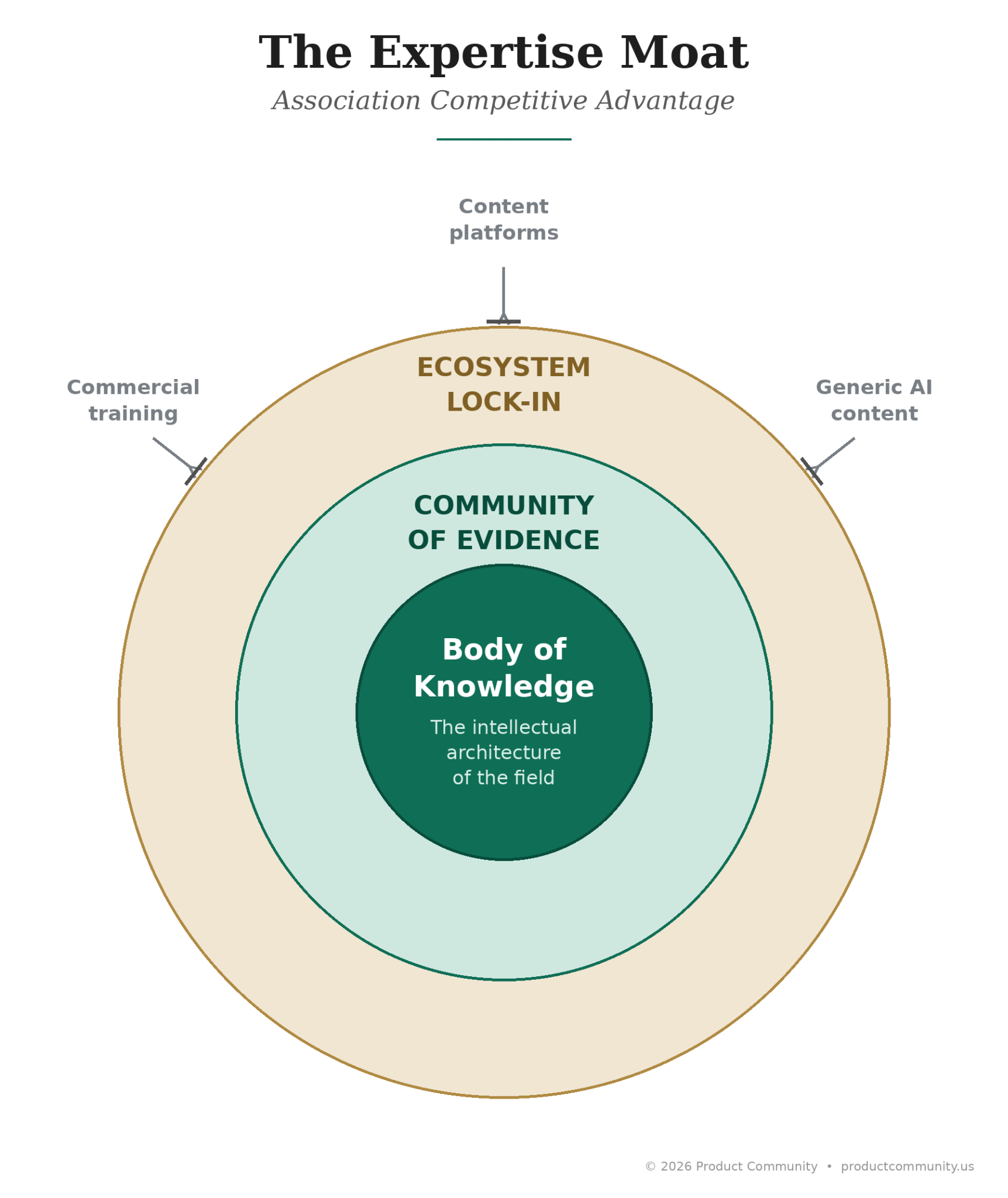
Collective expertise cannot be copied. A commercial competitor can hire instructional designers, but cannot replicate a practitioner community, peer review, decades of accumulated judgment, and the neutral convening role that give a BoK its credibility. The moat is a community of evidence standing behind the document.
Switching costs accumulate around a standard. When employers write job descriptions to your competency model, universities align curricula to your domains, and professionals plan careers against your framework, the entire ecosystem becomes invested in your architecture. That is differentiation that transcends any single product the shift from being different to being the singular choice.
It compounds against AI rather than losing to it. Generic knowledge is being commoditized at breathtaking speed. But AI systems are trained on what fields have codified which makes the governance of codification more valuable, not less. The association that stewards the authoritative, current, human-validated account of its field becomes more essential in an era of abundant, unreliable content, not less.
This is the expertise moat: a differentiated competitive position built not on any product but on owning the intellectual architecture of the field itself. Everything else you sell sits inside the castle it protects.
From Moat to Garden
“Value really emerges for customers when goods and services do something for them.”
Christian Grönroos
A moat protects value. The deepest returns come when a BoK shifts from fortress to garden. Recall the distinction between value-in-exchange and value-in-use. A BoK conceived as value-in-exchange is a product: we codify, we publish, members purchase or access. Useful but it captures only a fraction of our potential. A BoK conceived as value-in-use is a participatory system: value emerges when members apply it to their real problems, contribute their expertise back into it, and co-create its next version.
The BoK becomes a community design engine. The work of building and maintaining a BoK is an opportunity for high-impact contribution. Domain working groups, review panels, practice communities debating emerging methods. This is the Three Cs in action: members move from consuming the BoK, to contributing to it, to forming the community that stewards it. Contribution is how members experience belonging to something larger than themselves.

The BoK becomes compound value. Every cycle of contribution creates new resources (refined frameworks, documented cases, deepened relationships, visible reputations) that become inputs to the next cycle. As fallen leaves become soil nutrients, member expertise becomes community infrastructure. The BoK is where visible composting happens: the field’s knowledge accrues and members who contribute evolve into a healthy community.
The BoK becomes the trunk of a diversified revenue tree. Our portfolios should be built on a single intellectual foundation creating a value ladder: free foundational content establishes authority and acquires audience; courses monetize skill-building; certifications monetize professional advancement; licensing monetizes our standards; and advanced practice communities monetize belonging continually shaping the community. Each rung derives from, and reinforces, the same asset. Membership, as always, becomes an outcome rather than the price of admission.
It is our right and opportunity to own our fields. We bound our domain, organize our knowledge, and build our portfolios on top. The BoK is where authority, community, and revenue stop being separate strategies and become one system. The choice is ours. Are we the author of our field’s knowledge or just another distributor?
I lead the product community; we are a learning community because we believe great relationships help us create the value our members want. Remember, product-led growth fuels connection. Join the product community and flip your destiny.
About the Author
James Young is founder and chief learning officer of the product community®. Jim is an engaging trainer and leading thinker in the worlds of associations, learning communities, and product development. Prior to starting the product community®, Jim served as Chief Learning Officer at both the American College of Chest Physicians and the Society of College and University Planning. Please contact me for a conversation: james@productcommunity.us