
Immersive Membership
How the Psychology of Immersive Experiences Creates Long-Term Member Connection

Summary
When we’re immersed, we are connected and focused, engaged and alive. Immersion works best when grounded in the psychology of how we enter, engage with, and make meaning from our environments. This is how we should practice membership.
Joseph Nunes and Wendy Heimann write about theme parks and gaming, but their currency is belonging. Engagement is an ongoing challenge for associations. Members have ample options for networking and professional development. Our opportunity is to apply the concept of immersion to durable value that lasts the entirety of our members’ careers. Rooted deeply in ongoing care and community design, immersion becomes the reason to join, connect, tell your friends, and keep coming back for more.
This article translates six psychological dimensions of immersion to associations. There’s a difference between members who attend and members who contribute, connect, and create value.
I lead the product community, a product development learning community designed specifically for associations. Let’s compare ideas and build something great.
What is Immersion?
“People don’t join networks, platforms, or customer groups based exclusively on the economic value of individual features offered to them. They join in significant part because they want to be part of something: a culture, community, a crowd, a conversation.”
Roger Martin
In this article, we apply the concept of immersion to a designed member experience by focusing on relationship-building, active participation and engagement, long-term connection, and abiding loyalty. For framing, here is a standard definition.
An immersive experience completely surrounds and engages our senses, making us feel like we are an active part of a story or environment rather than just a passive observer. These experiences blur the boundary between the physical (using real-world sets, actors, sensory effects, and live performances to create transportive realities) and the virtual (utilizing technologies like augmented reality to place participants in simulated, interactive 360-degree environments). When people enter a new experience, they seek answers (consciously or unconsciously) to six questions, in sequence:
Where am I? (Presence)
Who am I with? (Discourse)
What can I do? (Agency)
What is happening? (Understanding)
Am I making progress? (Goal pursuit)
Why does this matter? (Meaning-making)
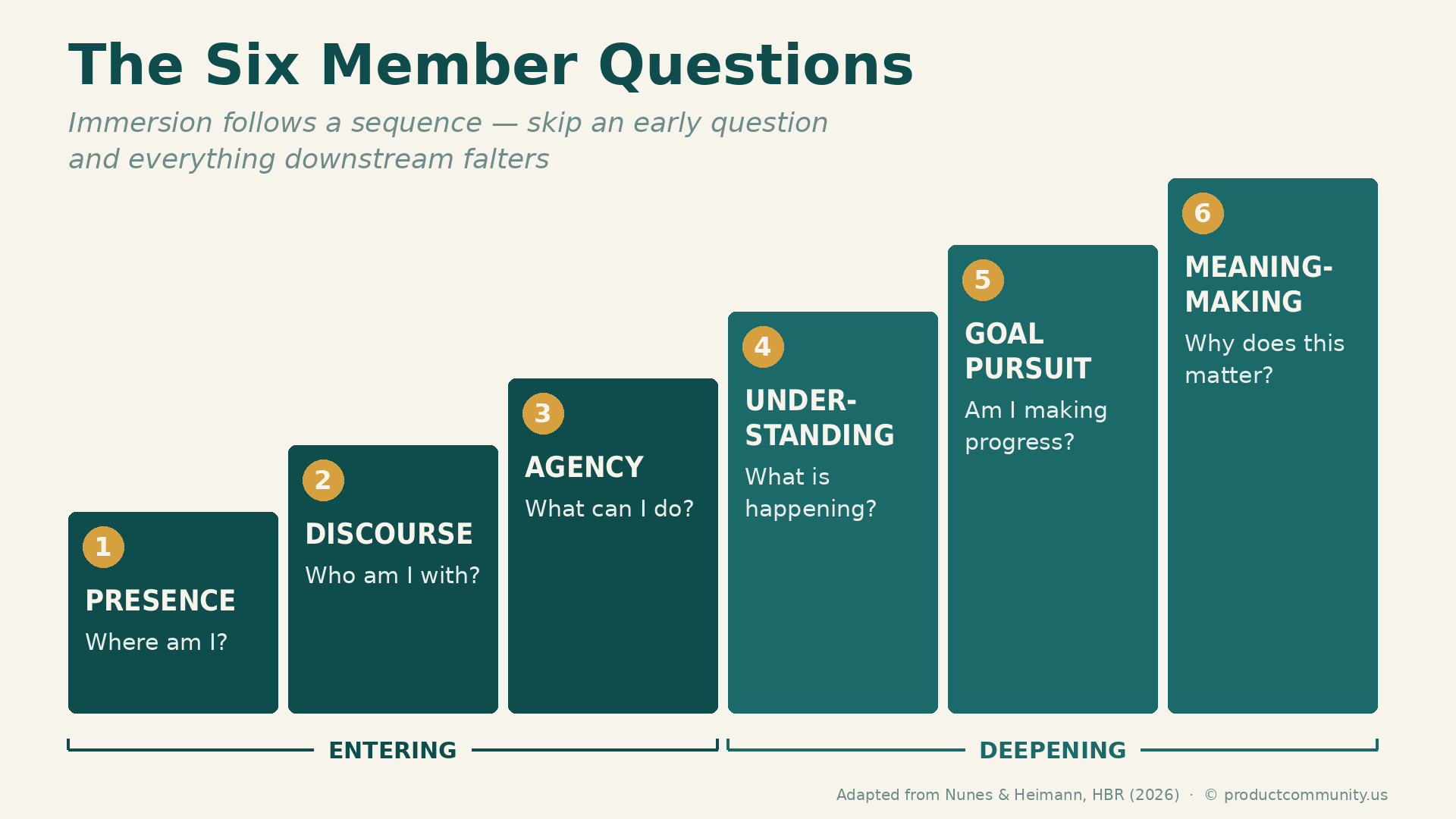
Skip an early question and everything downstream falters. Without orientation, it’s hard to achieve meaning; a participant who feels like a spectator doesn’t exercise agency. Now imagine these questions being asked by a member in her first 90 days.
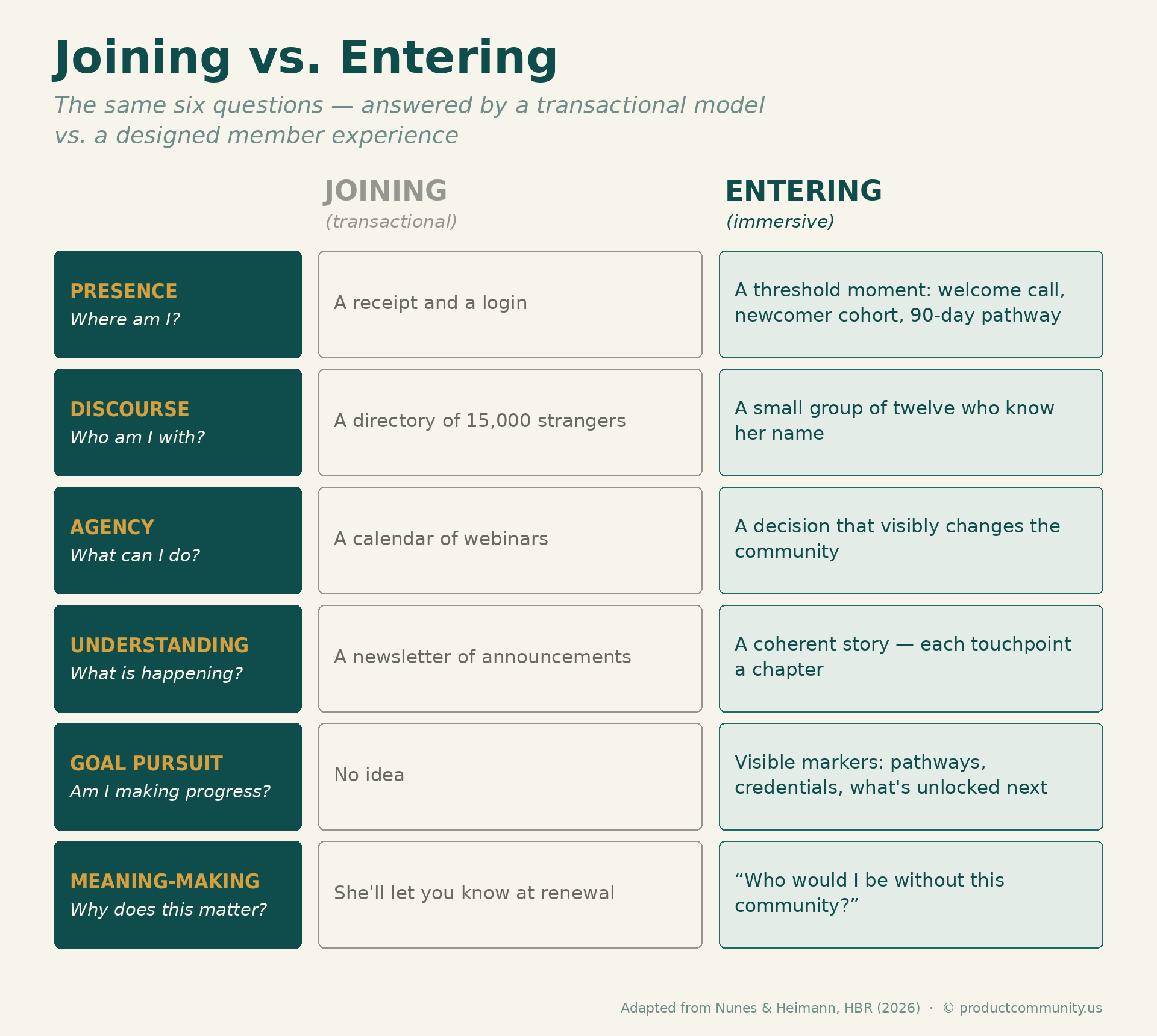
Where am I? She joined online in four minutes and received a receipt and a login. Who am I with? A directory of 15,000 strangers. What can I do? A calendar of webinars. What is happening? A newsletter of announcements. Am I making progress? No idea. Why does this matter? She’ll let you know at renewal time.
This is the core problem of the transactional membership model. People can join but not enter. Nunes and Heimann explain why so many impressive-looking experiences fail: they emphasize spectacle over psychology. Associations make a similar mistake by emphasizing offerings over experience without asking whether members can answer the six questions that turn presence into belonging.
The good news? We are structurally positioned to answer all six. A theme park has us for a day; we have members for a career.
The Six Dimensions
“When we shape products and experiences around deep customer understanding – removing friction, solving unarticulated problems, creating moments that feel personally designed – something accumulates beyond satisfaction.”
Paul Worthington
The first three dimensions govern how people enter and begin engaging.
Presence: Where am I? Immersive designers obsess over the threshold moment, the passage that signals that one has crossed into a different world. The design principle: before anything meaningful can happen, people need to feel grounded enough to say, I know where I am.
Most associations lack a threshold; joining is a payment confirmation. Compare this to a designed arrival: a welcome call from a member within the first week. A cohort of fellow newcomers who start together. A first-ninety-days pathway that says, unmistakably, you are here, and here is what our world looks like. Onboarding is a ride to belonging, the moment a member’s perception shifts from “I bought something” to “I arrived somewhere.”
Discourse: Who am I with? Engagement deepens when experiences unfold as dialogues rather than scripted, one-directional performances. Humans calibrate who they are through back-and-forth exchange.
This is where our programming often fails. The webinar, keynote, and content library are one-way experiences. Members watch, read, or consume. Real connection happens in small groups: the committee, chapter, or SIG: where people know our name and our input can influence what happens next. Discourse is the mechanism that makes small groups work: it’s how a member stops being one of 15,000 and becomes one of twelve.
The design question: in a member’s first year, when is she spoken with rather than broadcast to? If the answer is “at the registration desk,” we’ve designed for spectators.
Agency: What can I do? Self-determination theory tells us that motivation rises when people feel their choices have visible consequences. Immersive experiences engineer this deliberately: at least one decision must observably alter what happens.
For associations, this is the bridge from consumption to contribution: the central move in the Three Cs. A member exercises agency the first time she facilitates a discussion, reviews an abstract, mentors a newcomer, shapes a committee’s direction, and sees the community change because of it. Too many volunteer experiences are interactivity without consequence: feedback that vanishes, task forces recommendations that gather dust, choices that feel cosmetic. Agency ensures that what we do matters.
The other three dimensions determine whether immersion deepens or dissipates. This is where episodic engagement becomes longitudinal engagement.
Understanding: What is happening? People absorb experiences as narrative beats to be assembled into a coherent whole. Nunes and Heimann call this temporal coherence, the linking of what’s happening now to what came before and what comes next.
Most member experiences have no narrative. Events, courses, and emails arrive as disconnected episodes, what the authors call “moments rather than parts of a connected whole.” The member journey map is our tool for building coherence: it reveals the professional story the member is living, so that each touchpoint can land as a chapter in the story. When the leadership program references what she learned in the mentoring circle, and the committee invitation arrives because of what she contributed at the conference, the member can finally say what every immersive designer wants a guest to say: this makes sense.
Goal pursuit: Am I making progress? Super Nintendo World gives guests Power-Up Bands that track achievements and unlock new experiences. Progress is visible; momentum builds. Decades of goal-setting research explain why: people continuously monitor the gap between where they are and where they’re headed.
Associations have the ultimate progress architecture hiding in plain sight: the career itself. Learning pathways, credentials, micro-credentials, and leadership pipelines are our progress markers. But Nunes and Heimann framework sharpens the design standard: repeat visits should feel cumulative, not redundant. Does year six of membership feel different from year one? Does the member see what she has unlocked and what remains ahead? If every year of membership looks identical (same conference, same renewal notice, same benefits sheet) we’ve built an impressive environment that feels stagnant.
Meaning-making: Why does this matter? The most powerful experiences change how people see themselves. People leave with a changed sense of how decisions echo across time.
Meaning-making is identity work. The transformation emerges when members say “I am a professional who belongs to something larger than my job.” This is the deepest answer to the renewal question, because people don’t cancel their identity. When the annual invoice arrives, members who have only consumed ask, “Did I get my money’s worth?” Members who have made meaning ask a different question entirely: “Who would I be without this community?”
Nunes and Heimann also stress the managerial audit: at any point, leaders should be able to test each dimension explicitly. Here’s the association version:
Presence. Can a new member say where she has arrived within her first thirty days? Is there a genuine threshold moment?
Discourse. Where in the first year is each member personally acknowledged: addressed by name, asked a question, given a response that reflects her input?
Agency. List every decision a member can make. For each: Does it change anything? Is the impact visible to her? Does it compound over time?
Understanding. Could a member narrate her own journey with you as a story: this happened, which led to this, which is building toward that?
Goal pursuit. What are your indicators of engagement? What visible markers tell a member she has advanced, and what do they unlock?
Meaning-making. If a member described her association after the annual meeting, would she talk about the logistics or about who she is becoming? The recall should focus on significance, not spectacle.
Remember sequencing: fix the earlier questions first. A brilliant credentialing pathway (goal pursuit) can’t rescue a member who never felt oriented (presence) or acknowledged (discourse). This is why bolting a mentoring program onto a broken onboarding experience so often disappoints. We’re answering question five for people still stuck on question one.
Connecting Immersive Experiences
“Our search is never for a thing but for the feeling we think the thing will give us.”
Jay Shetty
Immersive entertainment companies spend millions of dollars to manufacture, for a few hours, what associations possess naturally: a real world of shared purpose, populated by peers, spanning a professional lifetime. They rent immersion; we can own it, but only if we design for it. For associations, immersion is a long-term, relational proposition. Our job is to connect people and ideas, ultimately creating an indispensable community of practice.

An association where members can answer all six questions — I know where I am, I know who I’m with, my actions matter, this makes sense, I’m making progress, and this is shaping who I am — shepherds community. This is the deepest form of compound value: connection that grows richer with each passing year, until the association isn’t something a member belongs to, but somewhere she thrives professionally.
Start small. Pick the dimension where you’re weakest (for most, its presence or discourse) and run a small experiment this quarter. Design a threshold moment for new members. The best immersive experiences succeed because they treat human psychology as an explicit input. Over time, the investment becomes paramount.
I lead the product community, a product development learning community designed specifically for associations. Let’s compare ideas and build something great. Remember, product-led growth fuels connection.
About the Author
James Young is founder and chief learning officer of the product community®. Jim is an engaging trainer and leading thinker in the worlds of associations, learning communities, and product development. Prior to starting the product community®, Jim served as Chief Learning Officer at both the American College of Chest Physicians and the Society of College and University Planning. Please contact me for a conversation: james@productcommunity.us