
Designing for Deep Connection
How to Resist Transactional Member Engagement, Flat Retention, and Event Dependency

Summary
Our overarching goal is get members to engage meaningfully over time. The annual conference ends on a high note: record attendance, glowing exit surveys, packed sessions and yet three months later, renewal rates are flat, engagement is thin, and the community platform is quiet. The reason? We fail to design for the full experience.
In his book Emotional Design, Don Norman argues that all experiences operate on three levels: visceral, behavioral, and reflective. Our goals is to design for lasting, emotionally resonant connection that keeps members coming back. Most associations invest heavily at the first two levels; few design for the third. This article addresses the full span with clear implications for community and revenue.
I lead the product community, a product development learning community designed specifically for associations. Let’s compare ideas and build something great.
The Framework
“Making something simple is difficult.”
Don Norman
Norman’s three levels work simultaneously, each activating different cognitive and emotional responses. The visceral level is immediate and pre-rational. It is the brain’s first-pass evaluation: is this safe and engaging? It happens before members read the program description. It is the conference badge, opening video, look of your learning platform, and warmth of a welcome email. Visceral response is foundational. It sets the emotional conditions for everything that follows.
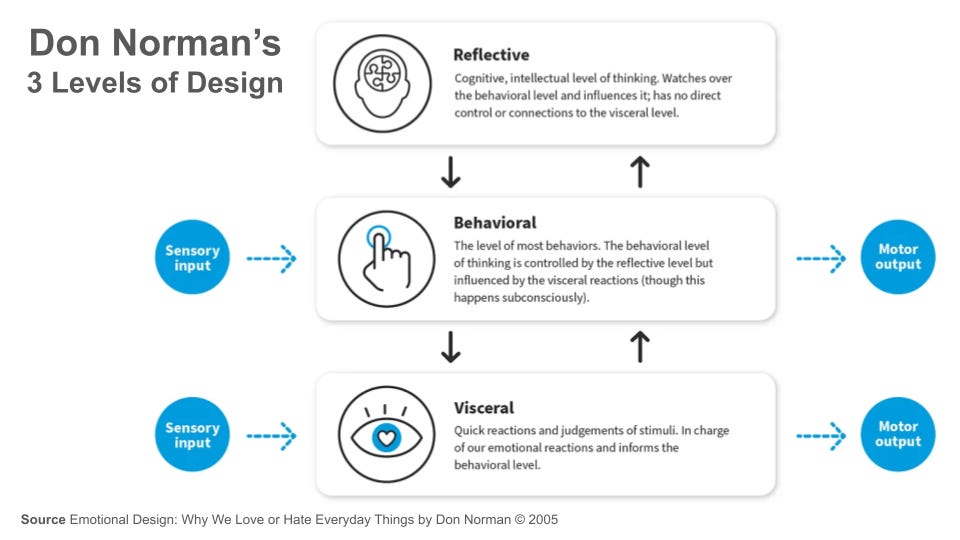
The behavioral level is typically where the member experience lives. It is usability, function, and flow. It is the texture of daily participation. Can a member easily find what they need? Does the cohort deliver what it promised? Do the tools work? Does the content resonate? Behavioral satisfaction comes from well-designed interaction: things that feel responsive, relevant, and worth the effort.
The reflective level is the highest and most durable level. It is the cognitive and emotional evaluation that happens over time. It is where members ask: Does this belong in my professional life? Does it reflect who I am becoming? Would I recommend it? Reflective design produces the stories people tell about an organization, the identity claims members make (“I’m an AIGA member” or “this community changed my career”), and the loyalty that persists through thick and thin. An experience that hits all three levels has the potential to make our associations indispensable.
Our focus, however, tends to be visceral: brand, conference production value, the aesthetics of onboarding. First impressions can determine whether a prospective member joins. The opening keynote, quality of the digital experience, and tone of the welcome email are visceral signals that communicate if we are serious, modern, and worth the investment. The moment a new member clicks past the homepage or registers for their first program, visceral shifts to behavioral.
Behavioral-level failures are almost always related to friction: a clunky online community nobody uses, the conference app that doesn’t extend relationships after the event ends, a learning pathway that doesn’t progress, or a cohort program that promises peer connection but delivers mostly sequential webinars. Members consume but aren’t compelled to contribute. The architecture of participation is simply not designed to invite them deeper.
Moreover, our programs are designed from the inside out built around what is convenient to produce rather than what members need. We operate in budget cycles, not member conversations. We build what we can fund, then wonder why engagement is transactional. Prototyping is a most direct path to knowing whether your behavioral-level design serves the people you built it for. The build-measure-learn loop is a practice in empathy.
The reflective level is our real deficit. We are, by nature, reflective. We exist to advance careers and communities over time. And yet most of our products are designed for short-term behavioral satisfaction rather than long-term reflective practice. For instance, the annual conference is optimized for four days and certification programs are optimized for a passing score. We focus on consumption and completion when we should design to make members feel that the association is a central part of our member’s professional identity.
Visceral Design and the Architecture of Belonging
Visceral design is the first signal of belonging. Before a new member evaluates our programs or community, they ask: Do I belong here? Is this a room I want to be in?
This is why onboarding is a high-leverage investment. Visceral design sets the emotional baseline for all subsequent experiences. A clunky, generic, automated welcome sequence communicates that members are a record in a database, not a person in a community. Getting it right requires choice: mapping the first ninety days of membership and removing unnecessary barriers to a meaningful first experience. Investing in the signals of belonging: language, aesthetics, the sense that something alive is happening. The first impression is an emotional contract.
But visceral design alone is a trap. The wow factor needs to lead somewhere. When the production quality of the annual conference vastly exceeds the quality of year-round engagement, members notice the contrast. Visceral investment without behavioral follow-through trains members to expect events and ignore everything else.
Behavioral Design and the Empathic Product
For the behavioral level to work it must be iterative. As we are mostly structured for production, we can overlook its power.
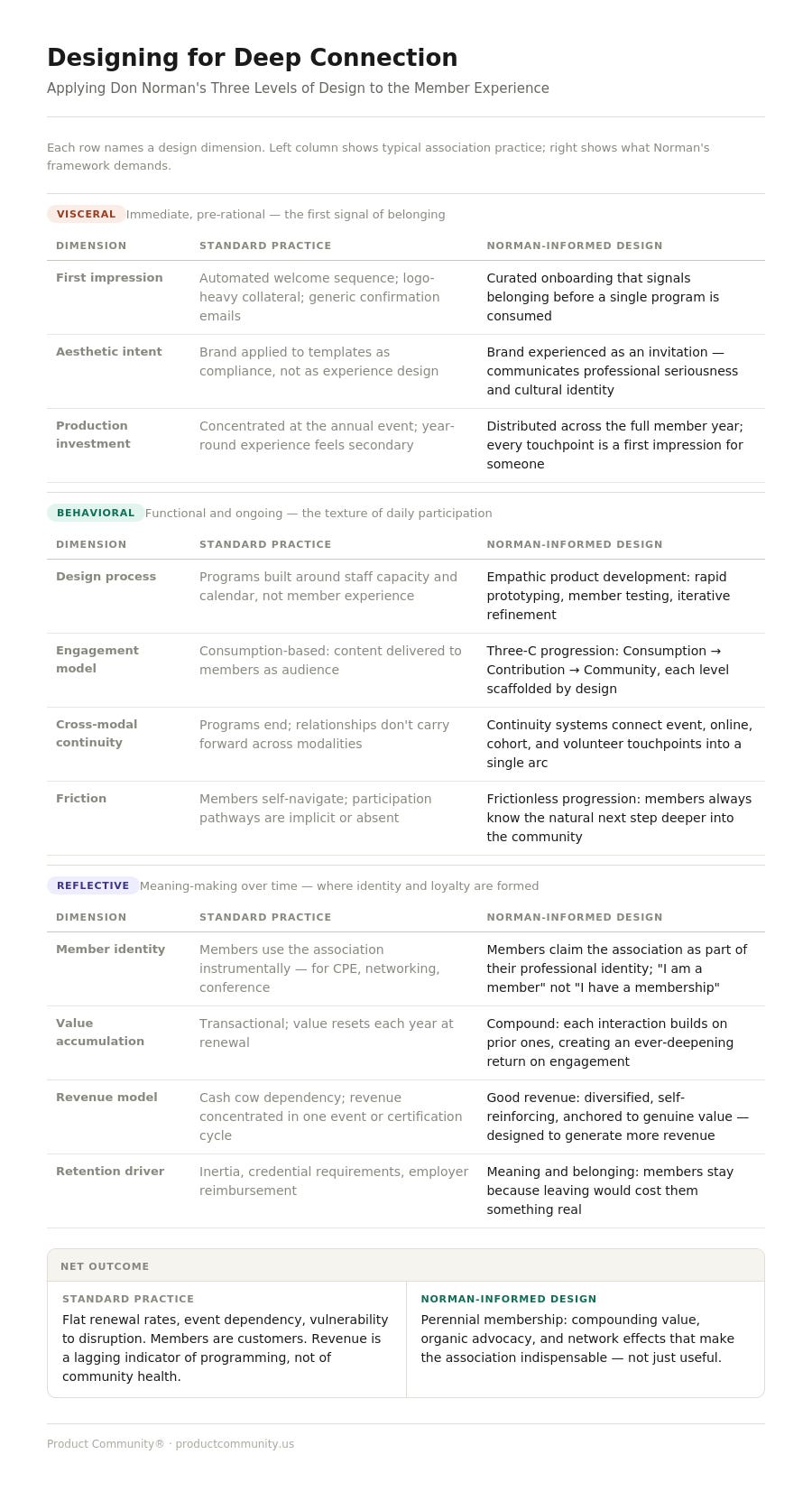
Good behavioral design starts with a clear and empathic answer to: what is this member trying to accomplish and what would make it feel easy, satisfying, and meaningful? This requires empathic product development or the practice of staying close enough to members, through prototyping, conversation, and observation. Only then, do we begin to design from their experience (as opposed our imagined perception).
Behavioral design works when a healthcare administrator discovers a best practice framework in an online community that she brings to her team Monday morning. It works when a mid-career engineer completes a learning cohort and begins thinking differently about a persistent professional problem. The mark of great behavioral design is when members experience growth in capability.
Behavioral design also governs the architecture of the Three-C model: the progression from Consumption to Contribution to Community. Most associations design primarily for consumption. Our behavioral systems are built to deliver content: to move members through a learning experience, event agenda, or resource library. Contribution and community require a different kind of scaffolding: invitation structures, feedback loops, recognition systems, cross-modal pathways. The member who goes from passive consumer to active contributor has a different behavioral experience than the passive attendee. This difference is intentional design.
This is where longitudinal engagement is architecturally important. If the behavioral experience is designed only for discrete interactions (events, courses, webinars) then the gaps between become opportunities for disengagement. The associations that design across the entire membership lifecycle design for continuity: systems that carry relationships forward, reconnect members across modalities, and make the time between touch points feel like an extension of community.
Reflective Design and Compound Value
The reflective level is the most powerful. It is about whether, six months later, a conference affects how members think about their profession and whether the association becomes part of a member’s professional identity. It is something members invoke when describing who they are and where they are going.
This is compound value. Just as compound interest accrues on both the principal and the accumulated interest, compound value accrues across every meaningful member interaction. A workshop generates insights, those insights inform a project which surfaces connections to other members. Those connections evolve into collaborations. The collaborations produce new knowledge that the association then shares across the community. The cycle reinforces itself. Each touchpoint becomes more valuable because of every touchpoint that preceded it.
This compounding effect is the financial expression of reflective design. When members experience an association as part of who they are professionally, their lifetime value grows. These reflective members become advocates, recruiters, mentors, and contributors. They are the ones doing the selling for you.
This extends to revenue. Bad revenue is transactional: it meets this year’s budget by extracting value from members who have not yet found a reason to disengage. Good revenue is generative: it grows from participatory value creation, compounds over time, and produces its own momentum. A nursing association with 92% renewal rates and members averaging eight-year tenures have operates at the reflective level. It is one that members have folded into their professional identity.
Cash cow revenue (the annual conference that generates 50% of budget in four days) is almost always a behavioral-level success and a reflective-level failure. It creates a great experience that dissipates. We fail to capture compound value because the architecture of engagement ends when the event ends: connections made are not designed to continue, insights generated are not structured to compound, and the enthusiasm of a great conference is not channeled into the kind of sustained contribution and community that produces deep and abiding resonance.
Designing Across All Three Levels
“For the communities, it’s about unifying themselves around a common cause which transcends money and education and any other stratifying factors, but which also somehow accommodates them, too: everything and everyone is connected.”
Niall Stewart
Why I Really Wish I Played Team Sports
The strategic question for associations is whether you have designed your member experience to succeed at each level with sufficient intentionality to carry members from the visceral moment of first impression through the behavioral architecture of ongoing participation into the reflective territory of professional identity and compound belonging. A few principles I’ve found useful in thinking about this:
Visceral design opens the door. Invest in the first impression, but never at the expense of the sustained experience. The quality of annual conference production means nothing if your year-round digital community feels abandoned. Design your onboarding experience not just to welcome members but to immediately surface the behavioral pathways that will move them from consumer to contributor.
Behavioral design should be built from member experience, not staff convenience. Prototype early and imperfectly. Test assumptions before building systems. Stay close to members through direct conversation and observation. The goal of behavioral design is frictionless progress toward member-defined success, not efficient delivery of association-defined content.

Reflective design requires longitudinal thinking. We create reflective resonance through an accumulation of meaningful experiences over time. These experiences are designed to connect, build on each other, and position member growth as a function of community: Recognition systems, mentorship pipelines, contribution pathways, and cross-modal community design are all tools of reflective architecture.
Compound value is a metric of reflective design. It happens when revenue grows because members go deeper, advocate more, contribute more, and invite others to join. If revenue is stable because of inertia and switching costs, we are consuming financial and relational capital. Move beyond measuring what members do this year toward what they do differently next year because of this year’s experience.
Making the Move
“Whatever you do – whether you’re a janitor or CEO – you can continually look at what you do and ask how it connects to other people, how it connects to your big picture, how it can be an expression of your deepest values.”
Amy Wrzesniewski
Associations are ideally positioned to operate at all three levels of Don Norman’s framework. We have the long-term relationship structure that makes reflective design possible, the community infrastructure that makes behavioral design scalable, and the mission clarity that gives visceral design authentic meaning.
However, if we lead associations that rely heavily on a single high-production event, an aging certification program, or a quiet digital community, I invite you to audit your offerings through Norman’s lens. Ask which level each of your products is designed to satisfy and then ask what it would take to carry that product one level deeper.
To meet the future, we need to operate as designers. To envision and carry out a forever member experience, we focus on the perennial which is the foundation of everything that matters: community, compound value, good revenue, and an association that earns and replicates its distinct indispensability.
About the Author
James Young is the founder and Chief Learning Officer of Product Community®, a consulting practice specializing in association transformation through community-driven design, empathic product development, and longitudinal member engagement. He is the author of the forthcoming Perennial Connection: Community Design for Striving Associations and writes The Innovative Association on Substack.