
Maximum Leverage
Extending our core strengths to identify, reach, and engage adjacent markets

Summary
Ideas abound. This has always been my experience: someone on staff champions a new program, a board member funds a pet project, a vendor pitches a new platform. Hustle, hustle, hustle. The unfortunate result, however, is often a bloated portfolio of disconnected offerings, each competing for the same limited attention, staff capacity, and member goodwill.

What if we could innovate with focus and intention? The Ambition Matrix, developed by Bansi Nagji and Geoff Tuff, provides a framework to help us identify, extend, and leverage our underutilized content and ideas in order to create new value and/or find new markets. This is an article about focused resourcefulness: empathizing with who we serve, deeply understanding what we do, optimizing it for maximum reach, and using this foundation to create and embolden a thriving community.
I lead the product community, a product development learning community designed specifically for associations. Let’s compare ideas and build something great.
What Is the Ambition Matrix?
“Most innovation efforts fail not for lack of creativity, but for lack of portfolio discipline.”
Bansi Nagji and Geoff Tuff
I have written about our wobbly value proposition. Membership is declining. Annual conferences reach maybe a third of membership. Publications have lost their advertising revenue and much of their relevance. AI is rapidly replacing members’ need for us. The offerings that once defined us (and still generate most of our revenue) are slowly aging into irrelevance.
The pressure to innovate is real, but the response is often misguided. We launch new programs without a strategy, pile offerings onto an already overcrowded calendar, and wonder why engagement remains uneven. We mistake activity for innovation and novelty for value. The Ambition Matrix helps us escape this trap by asking a clarifying question before we build anything new: where does this initiative live in relation to what we already do and who we already serve? The answer determines the level of risk, the required investment, and the probability of success.
Nagji and Tuff position innovation along a spectrum defined by two variables: how we leverage our existing offerings and how we can better reach current and prospective audiences. From this spectrum, there are three zones of innovation.
Core innovation involves optimizing existing offerings for existing markets. This is where most associations spend their energy, protecting and incrementally improving what we already do. The annual meeting gets a new track. Webinars get a better platform. The certification program adds a new module. These are worthwhile investments, but they are not growth strategies.
Adjacent innovation involves taking what we do well and extending it: either into new offerings for existing members or into existing offerings for new audiences. This is the productive middle ground where we can achieve genuine grow. Yes, it requires some risk and experimentation, but it is grounded in proven capabilities and earned trust.
Transformational innovation involves building entirely new offerings for entirely new markets, the kind of moonshot thinking that can produce breakthrough success, but more often results in costly distractions. For most associations (resource-constrained, volunteer-governed, and operationally-focused) transformational innovation is not something we chase.
This article focuses on where can win: core and adjacent. Mastering the relationship between them is where the real opportunity lives. In a recent article, I argued that our greatest untapped resource is our cash cows: the conference content that disappears, the certification program whose alumni never hear from us again, the webinar recordings that sit unwatched in a digital archive.
Core innovation asks us to look at what we have with fresh eyes. It is about optimizing what exists while understanding why certain offerings resonate and who they truly serve, so we can build on that foundation. This is portfolio thinking in its most foundational form: a discipline of inventory, analysis, and honest evaluation.
The Growth-Share Matrix is a companion lens. Cash cows drive revenue, but they are also underutilized sources of value. A mature certification program that generates steady revenue but declining enrollment is a signal. It tells us something important about what members needed at one point and what they may need differently today. That signal is the raw material for adjacent innovation.
Before we can confidently move toward adjacent growth, we needs to do the unglamorous work of core clarity: mapping the portfolio, identifying what is working and why, understanding the member behaviors that each offering drives or fails to drive, and asking the disciplined question: are we fully leveraging what we already have?
Moving Into Adjacent: New Products, New Markets
“You don’t have to invent from scratch. You have to listen deeply enough to know what wants to exist.”
Margaret Wheatley
Adjacent innovation is where growth happens. Nagji and Tuff found that organizations that generate sustainable returns allocate roughly 70% of resources to core, 20% to adjacent, and 10% to transformational. Given our structural constraints and deep relational capital, associations focus most on core value (80%). This means our opportunity is creating adjacent value or reaching adjacent markets.
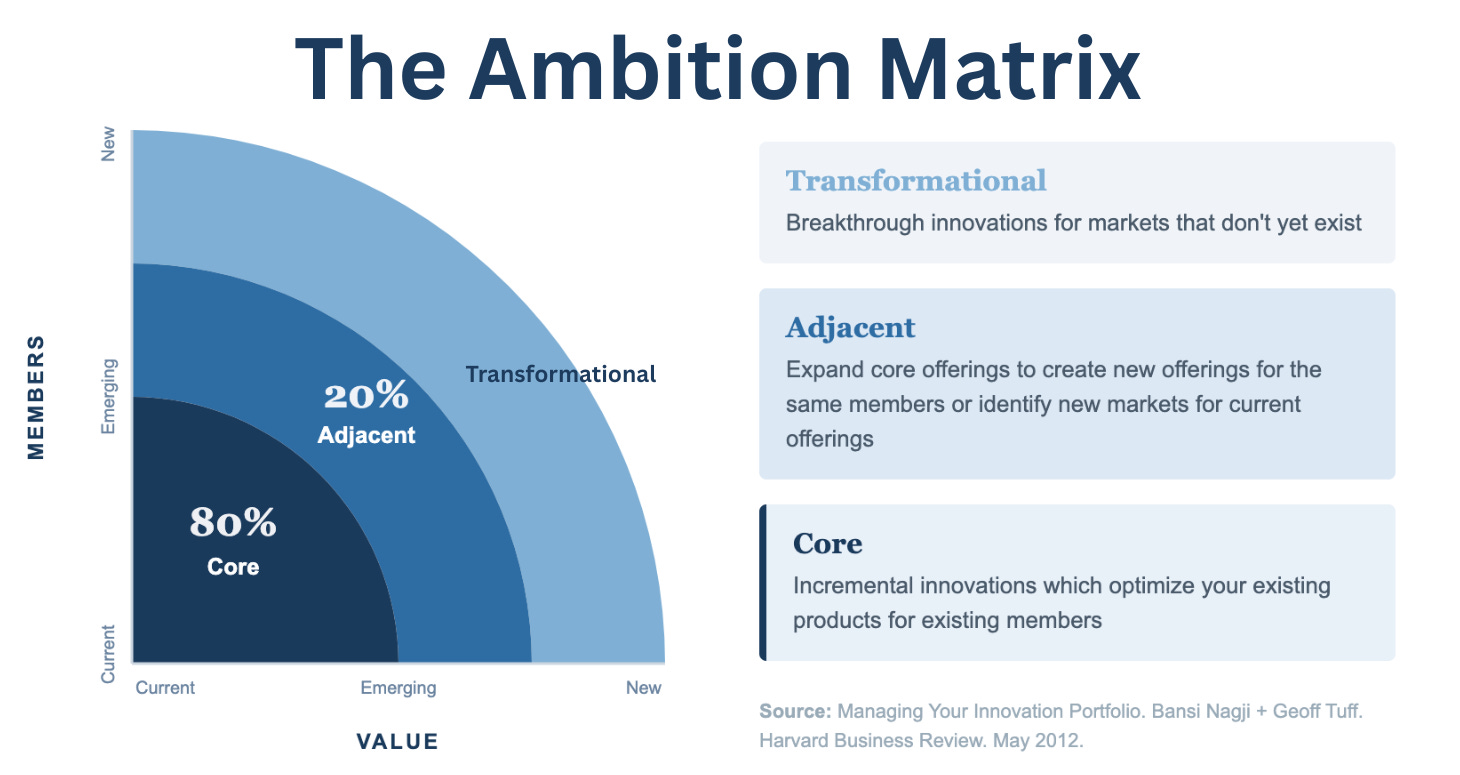
Adjacent innovation takes two primary forms for associations. The first is new products for existing members: taking what we know how to do and extending it to address unmet or underserved member needs. The second is existing products for new markets: reaching audiences adjacent to our current membership, whether that means early-career professionals, adjacent industries, or the members of related professions who would benefit from our expertise.
Both forms of adjacent innovation are grounded in the same prerequisite: a deep and honest understanding of our members. This is the data that reveals where they struggle, what they seek, and what they are willing to pay for. This is what I mean by continuous discovery: the ongoing habit of learning from our community so that innovation is always demand-driven rather than supply-pushed.
Consider a practical example. A healthcare association runs a successful annual meeting and an established certification program: two reliable cash cows. Core innovation might improve the meeting’s mobile app or update the certification exam. Adjacent innovation asks a different question: what do our certified members need in the two or three years after they earn their credential that we are not currently providing? The answer might be a peer learning cohort, a mentorship program, a specialized advanced credential, or a community of practice organized around emerging sub-specialties. These are natural extensions of what we already do, grounded in relationships we already have, serving needs we are uniquely positioned to meet.
I describe the critical discipline in my article about designing a portfolio: before we build the new thing, map the existing thing. Understand its reach, its revenue, its audience, its life cycle stage, and its connections to other parts of the portfolio. Adjacent innovation that grows out of this kind of disciplined portfolio work is far more likely to succeed than adjacent innovation born from inspiration alone.
The Community That Makes It All Work
“Snowflakes, leaves, humans, plants, raindrops, stars, molecules, microscopic entities all come in communities. The singular cannot really exist.”
Paula Gunn Allen
Here is where the Ambition Matrix becomes more than a planning tool, where it connects to our need for deeper transformation.
Both core and adjacent innovation, done well, require member involvement, well beyond passive survey respondents or focus group participants, toward the active involvement of members who are invested in our evolution. When members co-create value: contribute knowledge, design peer experiences, challenge each other’s thinking, and build on each other’s expertise the portfolio becomes regenerative.
This is the shift from a vending machine model to a community platform model. In the vending machine model, we design offerings, members purchase them, and the transaction ends. In the community platform model, we creates the conditions for value to emerge from the community itself and then organize, amplify, and extend this value. Over time, the Ambition Matrix evolves from a framework for what to build and who to reach toward a framework for collaborative value creation.
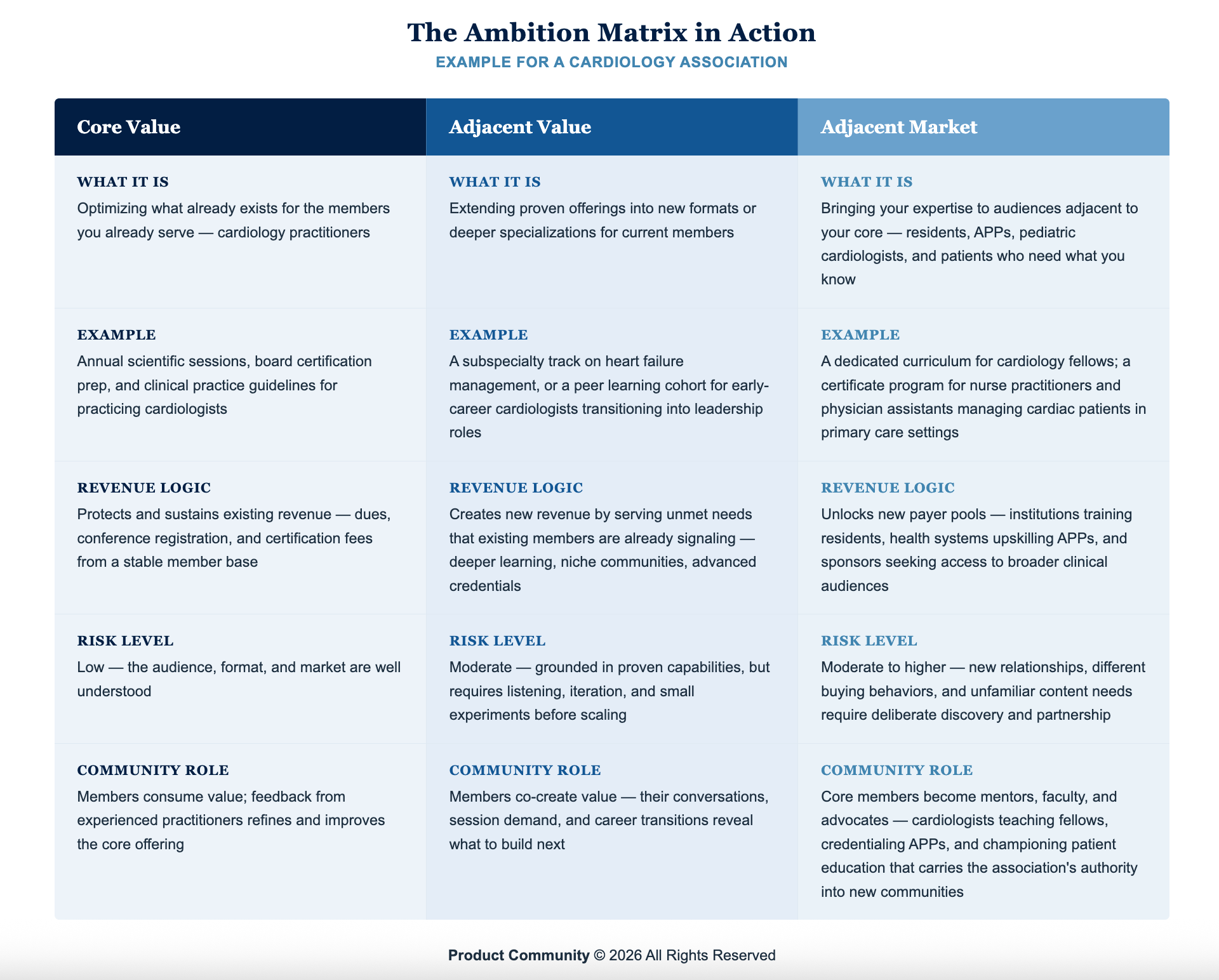
Adjacent innovation depends on community infrastructure. New products for existing members are likely to find a market when the community has identified the need through organic conversation, peer exchange, and the kind of honest problem-sharing that only happens in high-trust environments. New markets become accessible when existing members are genuine advocates and because they experienced something worth sharing. This is the compound effect of community-driven innovation: the portfolio and the community co-evolve, each making the other more valuable.
Building this kind of community requires a contributory mindset: a deliberate design choice to position members as value creators. It means designing offerings that invite contribution, not just one-way consumption. Peer learning circles over broadcast webinars. Collaborative research over published reports. Open member-generated content alongside curated expert content.
With a community that is contributory by design, core innovation becomes easier because we optimize offerings members recognize. And adjacent innovation becomes natural because the community is already surfacing the needs, testing the ideas, and providing the social proof that new offerings require to get traction. The Ambition Matrix evolves from a planning document to a living reflection of where our community is growing.
Putting It Into Practice
“Life was immediate and nothing was wasted.”
Jane Ziegelman
Don’t build something new until we fully mine what we already have. The Ambition Matrix challenges us to understand our members and take a hard look at our portfolio. Using the tools I have described, start by plotting existing offerings along the core-to-adjacent spectrum. Which offerings are pure optimization plays, the things we do to maintain performance in a mature market? Which are genuine adjacent moves: new offerings, new audiences, new formats that extend our capabilities in meaningful ways?

Focus on where our innovation energy is flowing. Most associations, if honest, will discover that nearly all of their energy goes into core. The conference has a deadline. The webinar needs promotion. The certification needs a content review. The adjacent horizon gets pushed to next year, and next year, and next year.
The Ambition Matrix helps make the case — to ourselves, to our boards, to our volunteers — that adjacent innovation is a survival imperative. And unlike transformational innovation, it does not require us to abandon what we know. It requires us to know it more deeply, leverage it more deliberately, and build on it with a community that is ready to grow alongside us.
The regenerative association knows its core so thoroughly and listens to its community so consistently that adjacent innovation feels less like a leap and more like a natural next step. That is the promise of the Ambition Matrix applied with discipline, community, and purpose.
I lead the product community, a product development learning community designed specifically for associations. Let’s compare ideas and build something great. Remember, product-led growth fuels connection. Join the product community and flip your destiny.
About the Author
James Young is founder and chief learning officer of the product community®. Jim is an engaging trainer and leading thinker in the worlds of associations, learning communities, and product development. Prior to starting the product community®, Jim served as Chief Learning Officer at both the American College of Chest Physicians and the Society of College and University Planning. Please contact me for a conversation: james@productcommunity.us.